
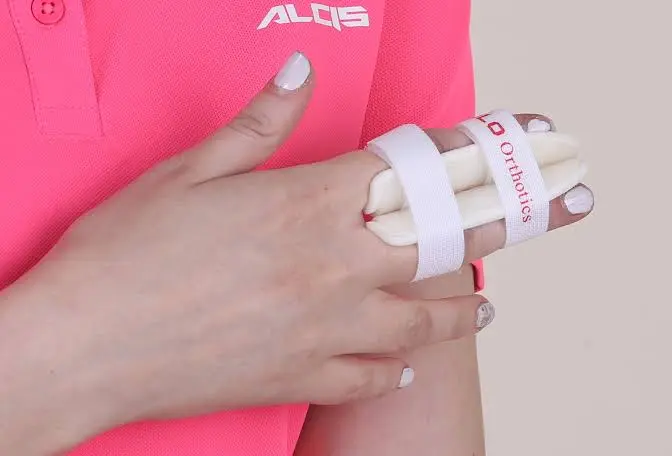
Buddy Static Finger Splint (Malleable)
Features
- Malleable Aluminium Core for Clinician-Shaped Custom Finger Positioning
- Foam-Padded Contact Surface for Comfortable Extended Immobilisation
- Volar, Dorsal or Lateral Application for Injury-Specific Positioning
- Buddy Configuration for Adjacent Finger Stabilisation & Controlled Motion
- Radiolucent Aluminium for Unobstructed Radiographic Assessment
- Trimmable & Cut-to-Size for Precise Digit Length Customisation
- Clinically Applicable Across a Broad Spectrum of Finger Injuries & Conditions
Buddy Static Finger Splint (Malleable) Mouldable Aluminium Foam Digital Immobiliser for Phalangeal Fractures, Finger Sprains, Tendon Injuries & Post-Surgical Finger Protection
The Buddy Static Finger Splint (Malleable) is a clinically versatile, immediately applicable digital immobilisation device constructed from a mouldable aluminium core laminated with a soft foam padding layer delivering the combination of rigid structural immobilisation, customisable positional adjustment, and skin-safe comfortable contact that defines the most practically effective and broadly applicable finger splint available across emergency, primary care, orthopaedic, and hand therapy clinical settings. Its malleable design allows the treating clinician to shape the splint to the precise joint angle, digit contour, and positional requirement of each individual finger injury at the point of application without heat guns, thermoplastic water baths, or specialised fabrication equipment making it the most rapidly deployable and clinically practical finger immobilisation option for acute injury management and outpatient hand therapy alike.
The Clinical Case for Static Finger Immobilisation
Finger injuries including phalangeal fractures, interphalangeal joint dislocations, ligament sprains, and tendon avulsions are among the most common musculoskeletal presentations encountered across emergency departments, sports medicine clinics, and primary care settings worldwide. Despite their prevalence and the frequency with which they are managed as minor injuries, inadequately immobilised finger fractures and dislocations carry a clinically significant risk of malunion, persistent joint instability, chronic pain, and permanent restriction of digital motion outcomes that profoundly impair the precision grip, keyboard function, instrument playing, and dexterous manual activities that define functional hand independence.
A finger splint holds the injured finger in one position immobilisation made of a rigid material with a cushion of foam or padded fabric to prevent pressure sores while wearing it whether a bone fracture or a damaged ligament or tendon, the finger needs time to recover before it can be used normally, and a finger splint makes sure no stress is placed on the finger while it heals. The buddy static finger splint fulfils this immobilisation function in a device that is simultaneously structurally effective, anatomically customisable, practically accessible, and patient-tolerably comfortable qualities that together determine whether a prescribed splint actually achieves the sustained daily immobilisation that clinical healing requires.
The Malleable Design Advantage: Customisation at the Point of Application
The defining clinical advantage of the malleable aluminium buddy splint over rigid prefabricated plastic finger orthoses is the capacity for immediate, tool-free positional customisation at the point of clinical application. While rigid plastic splints are manufactured in a fixed position straight, or at a predetermined fixed angle that may not precisely correspond to the individual patient's fracture reduction position, joint dislocation alignment, or therapeutic positioning requirement, the malleable aluminium splint can be bent by hand at the clinic, emergency department, or sports pitch to exactly the angle that the treating clinician determines is optimal for the specific injury pattern and healing phase.
This positional flexibility is particularly valuable in two clinical scenarios. First, in fractures where the reduction position is non-standard where the fragment requires a specific degree of flexion or extension to maintain the reduced alignment and prevent re-displacement the malleable splint can be precisely shaped to match and hold that alignment. Second, in progressive rehabilitation programmes where the immobilisation angle is incrementally changed as the fracture heals and controlled joint motion is reintroduced a new bend can be formed in the existing splint at each clinical review without requiring a new device, reducing material waste and simplifying the progressive mobilisation protocol.
Volar Application: The Standard Position for DIP Extension & Mallet Finger
The volar (palmar-side) application of the buddy static finger splint is the most commonly prescribed configuration for distal phalangeal injuries including distal phalanx fractures, mallet finger (extensor tendon avulsion at the DIP joint), and DIP joint dorsal dislocations after reduction. In volar application, the padded aluminium strip is placed against the palmar surface of the finger and bent to hold the DIP joint in full extension the position required to maintain the extensor tendon attachment at the distal phalanx in approximation during the six to eight week healing period of mallet finger, and to maintain the reduced distal phalanx fracture in alignment during consolidation. The volar position leaves the dorsal nail and skin surface accessible for inspection and monitoring of skin integrity without disturbing the immobilisation construct.
Dorsal Application: Preserving Palmar Sensory Access
For injuries where palmar skin access, sensory feedback, and functional finger contact with surfaces must be preserved during the wearing period, the dorsal application configuration positions the aluminium strip along the back of the finger maintaining the desired PIP or DIP joint position from the dorsal side while leaving the palmar fingertip surface free for tactile contact. This configuration is frequently used in the initial management of PIP joint volar plate injuries and middle phalangeal fractures where the clinical objective is to limit PIP extension beyond a defined angle while permitting progressive flexion a controlled motion approach that prevents volar plate scar elongation while avoiding the joint stiffness that complete immobilisation would impose.
The Buddy Configuration: A Neighbouring Finger as a Dynamic Support
The buddy aspect of this splint's design reflects one of the most elegant and clinically time-tested principles in digital injury management the use of the adjacent, uninjured finger as a living support structure for the injured digit. Two-finger splints secure the injured finger surrounded with metal or the adjacent aluminium and foam, then taped or bandaged to the finger next to it referred to as buddy splints the healthy neighbouring finger provides mediolateral stability against the rotational and lateral deforming forces that the aluminium strip alone cannot resist, while the buddy configuration simultaneously allows controlled flexion and extension of both fingers together the controlled motion that maintains tendon gliding, prevents joint stiffness, and supports the active range of motion exercises that are the foundation of effective digital fracture rehabilitation.
The buddy configuration is particularly well-suited to the management of stable proximal phalangeal fractures and PIP joint injuries where early protected motion rather than complete immobilisation is the clinically preferred approach, as the flexible coupling provided by the buddy loops allows the injured digit to participate in supervised motion exercises while remaining protected from the lateral and rotational forces that would destabilise the fracture or disrupt the healing ligament during the early weeks of recovery.
Emergency & Primary Care Application: Rapid Deployment at the Point of Injury
The malleable aluminium buddy splint is the ideal emergency and point-of-care digital immobilisation device requiring no heat source, water bath, specialised tools, or fabrication time, and applicable by any trained clinician within minutes of injury assessment. U-shaped aluminium splints are useful for distal phalanx fractures because they provide additional protection to the fingertip, with buddy-taping immobilisation being another tool for minor finger sprains the immediate availability and rapid applicability of the malleable aluminium splint make it the standard of care for acute phalangeal fracture immobilisation in emergency settings, with the splint providing immediate pain relief, fracture protection, and positional maintenance during the assessment, imaging, and definitive management planning process.
Post-Surgical Application & Wound Care Compatibility
Following surgical procedures involving the fingers including ORIF of phalangeal fractures, flexor tendon repair, extensor tendon repair, interphalangeal joint arthroplasty, and soft tissue reconstruction the malleable aluminium buddy splint provides the protective digital immobilisation required during the initial post-operative healing phase while accommodating post-operative dressings and wound care requirements. The splint can be applied over or alongside post-operative dressings without requiring the close skin contact that custom thermoplastic finger splints demand an important practical advantage in the immediate post-operative period when wound dressings, suture lines, and pin sites must be accommodated within the splinting construct without compromising sterility or wound protection.
Hygiene, Maintenance & Wearing Compliance
Suitable for skin contact, does not absorb perspiration, does not support micro-organism growth, washable, odour-free, tough, resilient and lightweight the aluminium core and foam lining of the buddy static finger splint are fully washable with mild soap and water, allowing the daily cleaning that is essential for maintaining skin health during extended digital immobilisation periods. The non-porous aluminium surface does not absorb sweat or harbour bacteria, and the foam lining is resistant to moisture degradation under normal washing conditions maintaining both structural integrity and hygienic performance throughout the full duration of the immobilisation period.
Indicated For:
Distal, middle, and proximal phalangeal fractures amenable to conservative management, PIP and DIP joint dislocations post-reduction, mallet finger (extensor tendon avulsion), volar plate injuries of the PIP joint, stable proximal phalangeal fractures requiring buddy immobilisation with controlled motion, soft tissue ligament sprains and collateral ligament injuries of the finger, hairline stress fractures of the phalanges, post-surgical digital immobilisation following finger reconstruction procedures, arthritis joint protection during inflammatory flares, jersey finger (flexor tendon avulsion) post-operative protection, and any clinical presentation requiring rapid, customisable, static digital immobilisation across emergency, primary care, orthopaedic outpatient, and hand therapy settings.
أضف مراجعتك
لن يتم نشر عنوان بريدك الإلكتروني. الحقول المطلوبة مميزة بـ *
الرجاء تسجيل الدخول لكتابة مراجعة!
يبدو أنه لا توجد مراجعات بعد.

M. A. Medical Supports