
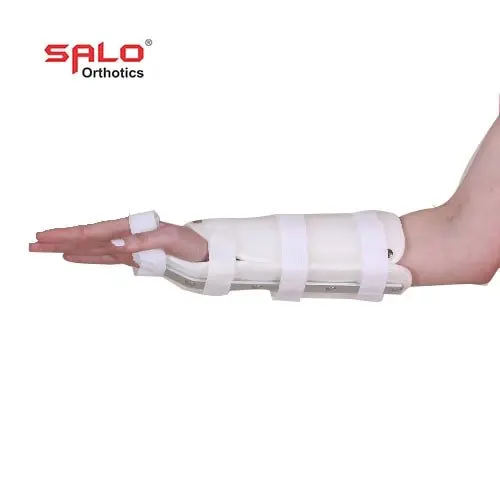
Forearm Brace with Wrist
Features
- Dual-Zone Support: Combined Forearm Counterforce & Wrist Immobilisation in One Device
- Wrist Extension Positioning to Reduce Common Extensor Tendon Loading
- Removable Dorsal Stays for Adjustable Wrist Rigidity & Progressive Rehabilitation
- Breathable Forearm Shell for Extended Therapeutic Wear Without Skin Irritation
- Clinically Indicated Across Lateral Epicondylitis, Wrist Pathology & Overuse Conditions
- Single-Pull or Multi-Strap Closure for Independent, One-Handed Application
- Applicable for Both Acute Injury Management & Chronic Overuse Rehabilitation
Forearm Brace with Wrist Support Combined Counterforce & Wrist Immobilisation Orthosis for Lateral Epicondylitis, Forearm Tendonitis, Wrist Injuries & Repetitive Strain Management
The Forearm Brace with Wrist is a clinically versatile upper limb orthosis that integrates the targeted counterforce compression of a forearm brace with the wrist positioning and stabilisation of a wrist support orthosis delivering a unified, dual-zone therapeutic system that addresses both the forearm extensor tendon overload and the wrist instability that together drive the most prevalent and functionally limiting upper limb overuse conditions encountered in occupational therapy, hand therapy, and sports medicine practice. By combining these two therapeutic mechanisms within a single, streamlined device, this brace provides a more biomechanically comprehensive management solution than either a standalone forearm strap or a simple wrist splint can deliver in isolation making it the clinically superior prescription for presentations where both forearm counterforce and wrist support are simultaneously required.
The Biomechanical Rationale: Why Combined Forearm & Wrist Support Outperforms Single-Zone Orthoses
The therapeutic logic of the Forearm Brace with Wrist is grounded in a detailed biomechanical understanding of how lateral epicondylitis pain is generated during functional hand use. During any gripping or wrist extension activity, two simultaneous mechanical events occur that together concentrate tensile stress at the common extensor origin at the lateral epicondyle: first, the extensor carpi radialis brevis and associated wrist extensor musculature are recruited to stabilise the wrist against the flexion moment generated by finger flexion during grip; second, the finger extensors and common extensor tendons are loaded by the resisting force of the object being grasped. Both of these loading events converge at the lateral epicondyle and both can be independently reduced through orthotic intervention.
Using the GRADE approach, there was evidence revealing a significant decrease in pain during contraction with forearm orthoses compared to a control condition, with improvements in pain-free grip strength with the use of a forearm orthosis confirming the pain-reducing effectiveness of counterforce compression at the forearm level. The wrist immobilisation component adds a complementary second line of mechanical offloading by holding the wrist in slight extension throughout functional activities, reducing the activation demand placed on the wrist extensors to maintain wrist position during gripping the precise mechanism responsible for the repetitive extensor tendon loading that drives epicondylitis pathology. The combination of both mechanisms within the Forearm Brace with Wrist therefore produces a greater overall reduction in common extensor tendon loading than either approach delivers alone.
Dual-Zone Construction: Understanding the Integrated Design
The Forearm Brace with Wrist consists of two structurally and functionally integrated components that work in concert throughout the wearing period. The forearm component whether a circumferential counterforce strap, a semi-rigid forearm trough, or a padded compression cuff positioned over the proximal extensor muscle belly delivers the muscle-belly compression that redistributes tensile forces away from the lateral epicondyle during wrist extension and gripping activities. The wrist component extending distally from the forearm section to encircle the radiocarpal joint and hold it in the prescribed extension angle provides the static wrist positioning that reduces extensor muscle activation demand and protects the wrist from the flexion loading that perpetuates both epicondylitis and intrinsic wrist pathology.
The forearm trough or shell extends from a proximal point approximately midway between the elbow and wrist to a distal end overlying the palm, with a gentle bend incorporated at the volar wrist surface that holds the wrist in a slightly extended orientation a structural feature that passively maintains the therapeutic wrist position throughout all daily activities without requiring the patient's active muscular effort, and that remains consistently effective even during activities that would otherwise cause involuntary wrist flexion under load. Adjustable straps at multiple levels connect and secure both components to the forearm and wrist anatomy, distributing the orthotic forces evenly across the skin surface and preventing migration during dynamic upper limb use.
Clinical Applications: Epicondylitis, Wrist Pathology & Overuse Conditions
The clinical scope of the Forearm Brace with Wrist is exceptionally broad, reflecting the large overlap between the patient populations who present with forearm tendon overuse pathology and those who simultaneously present with wrist instability, pain, or injury requiring positional support. In lateral epicondylitis (tennis elbow) where the forearm counterforce component provides immediate pain relief during gripping and the wrist extension positioning reduces wrist extensor recruitment during functional activities the combined brace addresses both of the primary biomechanical drivers of the condition within a single device. In medial epicondylitis (golfer's elbow), the forearm compression is repositioned over the medial flexor muscle mass, while the wrist component provides the same positional stabilisation benefit that reduces flexor tendon loading during wrist flexion and forearm pronation activities.
For wrist fracture rehabilitation including distal radius fractures, scaphoid fractures, and ulnar styloid fractures the wrist immobilisation component provides the anatomical support and motion restriction required during the transition from cast to functional brace management, while the forearm component adds structural stability to the forearm that supports the patient's proprioceptive confidence during the early return to functional activities. For radiocarpal joint instability, TFCC injuries, and wrist ligament sprains, the wrist extension positioning directly offloads the injured ligamentous structures, while the forearm component reduces the compressive and torsional forearm loading that would otherwise be transmitted to the wrist joint during daily activities. The palmar part of the orthosis can be equipped with an anatomically shaped, malleable, and removable forearm and palm strip accommodating radiocarpal joint dislocation, tendonitis and tendon strains, tenosynovitis, carpal tunnel syndrome, rheumatoid arthritis, overuse injuries, and post-traumatic and post-operative presentations.
Neurological Applications: Wrist Positioning in Neurological Conditions
Beyond musculoskeletal applications, the Forearm Brace with Wrist has important clinical utility in neurological presentations where wrist positioning is required to compensate for absent or impaired voluntary motor control. In central or peripheral neurological injuries including radial nerve palsy, brachial plexus injury, stroke with wrist drop, and peripheral neuropathy affecting forearm extensor function the wrist component provides passive support in the functional extension position that the neurologically impaired extensor musculature cannot independently maintain, restoring the hand to a posture from which functional grip and pinch can be executed with the remaining intact musculature. The forearm component adds structural support to the forearm brace assembly, improving overall wearing security and reducing the internal migration that can occur with wrist-only splints in patients with reduced proprioceptive feedback from neurological involvement.
The Advantage Over Standalone Devices: Comprehensive Management in a Single Orthosis
From a clinical management perspective, the Forearm Brace with Wrist offers a compelling practical advantage over prescribing separate forearm and wrist orthoses for the same patient: a single device that is applied and removed in a single procedure, maintained and cleaned as a single unit, and adjusted as a single integrated system reducing the compliance burden on the patient, eliminating the positional inconsistencies that arise when two separately applied devices interact unpredictably during daily activities, and delivering a more biomechanically coherent combined force system than two independently applied orthoses can achieve. For patients managing complex upper limb presentations with both forearm tendon pathology and concurrent wrist instability or injury, this single-device management approach offers meaningful clinical, practical, and economic advantages over multi-device prescription strategies.
Fitting, Wearing Schedule & Clinical Progression
The Forearm Brace with Wrist is worn during all activities that provoke forearm or wrist pain including sporting, occupational, and daily living activities with the wearing schedule progressively modified as the patient's symptoms and functional capacity improve throughout the rehabilitation programme. The dorsal stays within the wrist component can be removed sequentially to reduce rigidity and introduce controlled wrist motion as the patient transitions from the protection phase of rehabilitation into the strengthening and return-to-activity phase allowing the single device to be reconfigured to match the evolving clinical requirements of each rehabilitation stage without requiring a replacement orthosis. Regular clinical review ensures that the counterforce pad position, wrist extension angle, and closure strap tension are correctly optimised at each consultation as the patient's presentation evolves.
Indicated For:
Lateral epicondylitis (tennis elbow) with concurrent wrist instability, medial epicondylitis (golfer's elbow) with wrist involvement, forearm extensor and flexor tendonitis, repetitive strain injury with wrist component, distal radius and ulnar styloid fracture rehabilitation, scaphoid fracture management, radiocarpal joint dislocation, TFCC injuries, wrist ligament sprains and instability, carpal tunnel syndrome with forearm involvement, de Quervain's tenosynovitis, rheumatoid arthritis with forearm and wrist involvement, radial nerve palsy, brachial plexus injury wrist management, post-operative forearm and wrist rehabilitation, and any clinical presentation requiring simultaneous forearm counterforce compression and wrist positional support within a single integrated orthosis.
أضف مراجعتك
لن يتم نشر عنوان بريدك الإلكتروني. الحقول المطلوبة مميزة بـ *
الرجاء تسجيل الدخول لكتابة مراجعة!
يبدو أنه لا توجد مراجعات بعد.

M. A. Medical Supports