
Neck Support Memory Foam
Features
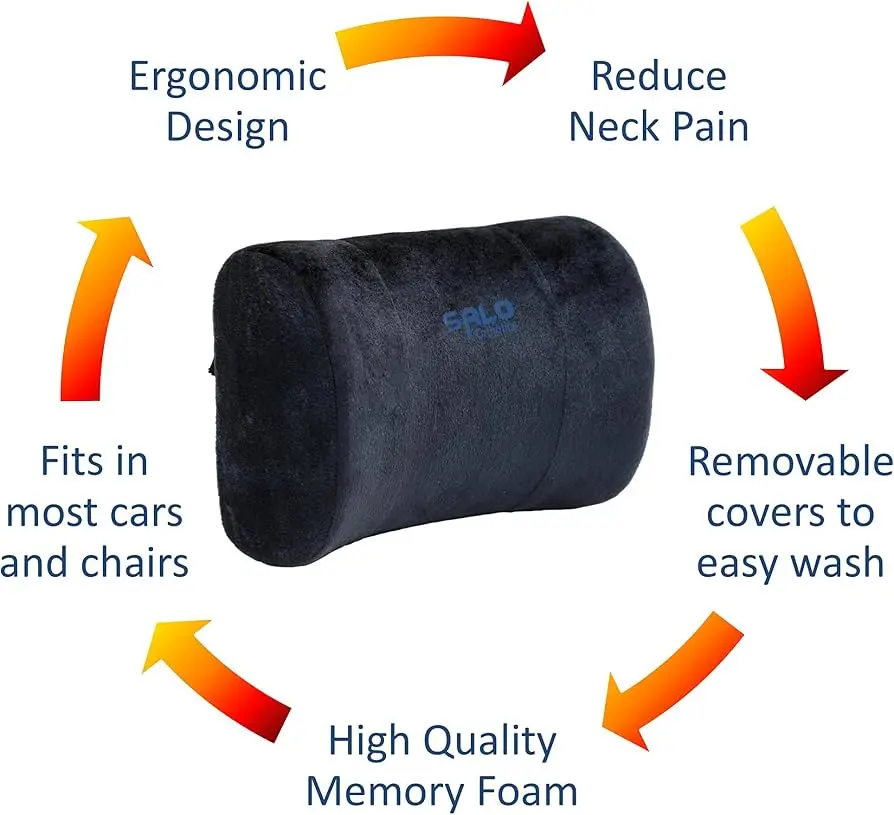
- Ergonomic Cylindrical Bolster Design for Targeted Neck & Lumbar Support
- High-Quality Memory Foam Core That Never Flattens or Loses Shape
- Reduces Neck Pain by Maintaining Correct Ear-Shoulder-Spine Alignment
- Fits Most Cars & Chairs for Versatile Seated Support Throughout the Day
- Dual-Purpose Use: Cervical Neck Support & Lumbar Back Support
- Removable Velvet Cover for Easy Washing & Long-Term Freshness
- Lightweight & Portable for Seamless Use Across All Seated Environments
Neck Support Memory Foam Roll Pillow Cylindrical Ergonomic Bolster Cushion for Car Headrest Support, Office Chair Lumbar Relief & Neck Pain Prevention During Prolonged Seated Use
The Neck Support Memory Foam Roll Pillow is a premium, ergonomically engineered cylindrical bolster cushion designed to deliver targeted postural support to the two anatomical regions most consistently compromised by prolonged seated posture the cervical neck and the lumbar spine. Constructed around a high-density, slow-rebound viscoelastic memory foam core and encased in a plush, removable velvet cover, this compact roll pillow provides the consistent, resilient, anatomically appropriate support that standard car headrests, office chair backrests, and generic cushions fundamentally fail to deliver addressing the primary biomechanical drivers of the neck pain, shoulder tension, and lower back stiffness that are among the most prevalent occupational and travel health complaints in the modern seated working and commuting population.
The Problem with Standard Car Headrests & Office Chair Backrests
The vast majority of car headrests and office chair backrests are designed around crash-safety and general ergonomic principles that prioritise broad population fit over individual anatomical accuracy. Standard car headrests are positioned to prevent whiplash in rear-impact collisions a safety function but their flat, angled geometry is rarely calibrated to support the individual driver's cervical curve in the neutral lordotic position during normal driving. The result is that most drivers travel with their head either not in contact with the headrest (leaving the cervical muscles to sustain the weight of the head unsupported for hours) or in contact with a headrest that pushes the head forward into cervical flexion the posture that is the primary driver of the forward head posture, cervical muscle fatigue, suboccipital headache, and posterior neck pain that characterise the clinical presentation of prolonged driving-related cervical dysfunction.
Office chair backrests present a similar challenge at the lumbar level while many modern ergonomic chairs incorporate lumbar support mechanisms, their fixed geometry rarely provides the individually calibrated support that the user's specific lumbar curve depth and sitting height require, resulting in either insufficient support that allows the lumbar spine to sag into flexion, or excessive support that pushes the lumbar spine into hyperextension. Either postural extreme generates sustained muscular tension, intervertebral disc loading, and facet joint stress that accumulate across hours of daily desk work into the chronic lower back pain that is a leading cause of occupational disability worldwide.
The Cylindrical Roll Geometry: Anatomically Optimal Support
The cylindrical roll profile of this memory foam pillow is not an arbitrary design choice it is the product of the ergonomic principle that a curved surface placed against a complementary anatomical concavity provides superior point-specific support compared to flat surfaces, which create a linear contact zone that misses the deepest point of the anatomical curve entirely. When the cylindrical roll is placed at the cervical level behind the neck in a car headrest or recliner, the circular cross-section of the roll fills the posterior cervical concavity at its deepest point the precise location where support is most critically needed to prevent the neck from dropping into flexion under the weight of the head. The memory foam's adaptive compression ensures that the roll conforms to the individual depth and width of the user's cervical curve, distributing the supportive contact pressure across the posterior cervical surface rather than concentrating it at a single point.
When the same roll is repositioned at the lumbar level behind the lower back in an office chair or car seat, the cylindrical profile fills the lumbar lordotic curve preventing the posterior pelvic tilting and lumbar flexion that occur when the spine is unsupported against a flat chair back, and maintaining the natural anterior lumbar convexity that distributes spinal loading across the posterior elements most effectively and reduces the compressive disc loading that prolonged lumbar flexion generates.
Memory Foam: The Material Science of Adaptive Support
The premium high-density memory foam core of this neck support roll pillow provides the specific combination of material properties that makes it clinically superior to standard foam, fibre, and latex roll pillows for ergonomic seating support. The viscoelastic composition responds to both temperature and pressure softening under the warmth of the body's contact zones and firming in cooler, unloaded regions to create a personalised support surface that conforms precisely to the individual anatomy of the neck or lumbar region without requiring manual adjustment. This adaptive compression distributes supportive forces across the broadest possible contact area, reducing peak pressure concentrations at bony cervical or lumbar prominences and providing the comfortable, pressure-relieving support that enables sustained use throughout a full working day or long-distance driving session.
The slow-rebound characteristic of the memory foam ensures that the roll returns to its original cylindrical profile after the user stands and removes weight from the pillow, maintaining its supportive geometry between uses and preventing the permanent compression set that causes inferior foam products to flatten and lose their therapeutic function over time. This dimensional stability means that the neck support memory foam roll pillow provides consistent, clinically effective support from the first day of use through months and years of daily application a long-term reliability that directly translates into sustained postural improvement and neck and back pain relief for the user.
Dual-Purpose Versatility: From Cervical to Lumbar Support
One of the most practically significant advantages of the cylindrical roll format over anatomically specific neck or lumbar support devices is its versatility across both support applications within a single product. Many users find that their primary postural support requirement varies between contexts requiring cervical neck roll support during car driving, when the headrest position determines cervical alignment, and lumbar roll support during desk work, when the chair backrest position and sitting posture determine lumbar alignment. The neck support memory foam roll accommodates both requirements simply by repositioning the same device to the appropriate height on the seat back, allowing the user to optimise their postural support for each seated context without carrying multiple specialised cushions between environments.
This dual-purpose versatility is also clinically relevant for users managing conditions that involve both cervical and lumbar postural components including cervicothoracic junction syndrome, thoracolumbar postural dysfunction, and the combined cervical and lumbar pain patterns that frequently co-exist in office workers and long-distance drivers whose entire spinal posture is compromised by sustained inadequate seated support.
Clinical Applications: Who Benefits Most
The neck support memory foam roll pillow is most clinically beneficial for individuals who spend substantial daily time in sustained seated postures including professional drivers, office workers, call centre operators, students, gamers, and frequent air travellers whose occupational or lifestyle demands impose prolonged periods of seated postural loading on the cervical and lumbar spine. Research shows that lumbar support cushions improve posture and comfort to ease low back pain chiropractors recommend lumbar support pillows to prevent slouching and significantly relieve low back pain from sitting and the same preventive and therapeutic principles apply to cervical support roll pillows in the context of neck pain from prolonged seated driving and desk work.
The pillow is equally applicable in the management of established cervical and lumbar conditions including cervical spondylosis, cervicogenic headache, lumbar disc disease, and chronic lower back pain where optimising seated postural support is a recognised component of the conservative management programme, complementing physiotherapy, manual therapy, and exercise interventions by reducing the sustained mechanical loading that perpetuates symptom provocation during the extended daily periods of occupational and travel seated activity that clinical management cannot eliminate.
Indicated For:
Neck pain and cervicogenic headache from prolonged car driving, office chair cervical fatigue and tension, forward head posture correction in seated environments, lower back pain from prolonged desk and computer work, lumbar postural support during driving and travel, cervical spondylosis symptom management during seated activities, lumbar disc disease seated support, long-distance travel comfort (car, airline, train), gaming and recliner neck and lumbar support, home sofa lumbar bolster support, and any individual requiring portable, versatile, dual-purpose cervical or lumbar postural support across multiple seated environments throughout the working and travelling day.
أضف مراجعتك
لن يتم نشر عنوان بريدك الإلكتروني. الحقول المطلوبة مميزة بـ *
الرجاء تسجيل الدخول لكتابة مراجعة!
يبدو أنه لا توجد مراجعات بعد.

M. A. Medical Supports