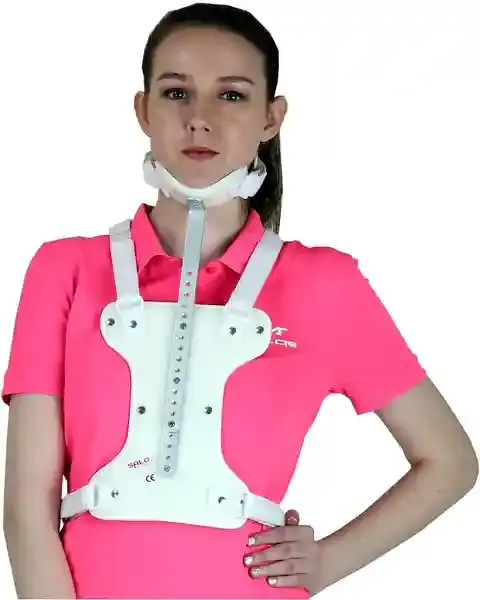
Torticollis Brace
Features
- Static-Dynamic Therapeutic Stretch for Progressive Neck Posture Correction
- Heat-Mouldable Upright for Individually Customised Corrective Force
- Flexible Upright Technology for Spasticity & Tone Management
- Adjustable Shoulder Cuff Anchor for Device Security & Alignment
- Clinically Indicated for Both Congenital & Acquired Torticollis
- Sensory Feedback Mechanism for Active Head Posture Correction
- Suitable for Paediatric & Adult Use Across a Wide Range of Neurological Conditions
Torticollis Brace Cervical Orthosis for Wry Neck Correction, Lateral Neck Contracture, Spasticity Management & Head Posture Rehabilitation
The Torticollis Brace is a clinically designed cervical orthosis engineered to address one of the most challenging and functionally disabling postural conditions encountered across both paediatric and adult rehabilitation practice torticollis, commonly known as wry neck. Torticollis, also known as twisted or wry neck, manifests as the contraction or contracture of neck muscles, resulting in head tilting, chin rotation, and flexion a deformity pattern that, when persistent or progressive, significantly impairs visual field, social interaction, occupational performance, and quality of life across all age groups in whom it occurs. The torticollis brace delivers a low-load, sustained corrective force to the shortened, hypertonic cervical musculature progressively encouraging the head and neck back towards midline alignment through a combination of passive static stretch and dynamic neuromuscular re-education that addresses both the structural and neurological components of the condition.
Understanding Torticollis: Aetiology, Prevalence & Clinical Impact
While torticollis is not a standalone diagnosis, it is a symptom of various underlying conditions, which can be congenital or acquired at any age. The congenital form typically appears within weeks after birth and is often isolated arising most commonly from shortening or fibrosis of the sternocleidomastoid muscle as a result of perinatal trauma, foetal positioning, or idiopathic causes. With an incidence from 0.3% to 1.3%, about 70% of head and neck abnormalities that appear in infancy or childhood are congenital muscular torticollis making it one of the most prevalent musculoskeletal conditions of infancy and a clinical presentation that virtually every paediatric physiotherapist, occupational therapist, and orthopaedic clinician will encounter regularly in practice.
In adults, torticollis arises most commonly through neurological mechanisms spasmodic torticollis (cervical dystonia), where abnormal involuntary co-contraction of cervical musculature drives persistent head deviation, accounts for the largest proportion of adult presentations, while acquired torticollis secondary to stroke, traumatic brain injury, multiple sclerosis, Parkinson's disease, and ALS represent a significant additional clinical burden. In all these presentations, the functional consequences of unmanaged torticollis are substantial: restricted visual field due to the fixed head tilt, social and psychological impact from the visible postural abnormality, secondary cervical pain and headache from the sustained asymmetric muscular loading, and progressive contracture of the periarticular cervical structures that drives increasing resistance to correction as the condition advances.
The Corrective Mechanism: Low-Load Passive Stretch & Active Neuromuscular Re-Education
The torticollis brace operates through two complementary therapeutic mechanisms that together produce a more effective and clinically sustainable corrective outcome than either would achieve in isolation. The primary mechanism is the low-load passive stretch delivered by the heat-mouldable semi-rigid upright a prolonged, gentle corrective force applied consistently to the shortened cervical musculature on the tilted side, exploiting the viscoelastic properties of the contracted tissue to achieve progressive elongation and range of motion improvement without generating the pain, reactive guarding, and muscle spasm that aggressive stretching invariably provokes. The brace permits relaxation of tension, while the insert can be moulded for a gradual correction of neck posture if there is spasticity or tone with underlying shortened tissue, the tone needs to be worked through, after which a low loading passively applied stretch can help to re-lengthen the shortened muscle tissue.
The secondary mechanism and the feature that distinguishes the torticollis brace from simple cervical collars is the sensory feedback component. This particular custom neck collar with negative sensory feedback is a simple but novel brace developed to provide sensory stimulation to prompt the patient to actively hold their head in a corrected posture with tactile cues at the skin surface continuously informing the patient's central nervous system when the head has deviated from the corrected position, triggering an active voluntary correction response that builds cervical proprioceptive awareness and active postural control over time. This active neuromuscular re-education component is clinically important because it addresses the neurological as well as the structural dimension of torticollis developing the patient's capacity for independent postural control that will persist beyond the period of brace use, rather than simply providing passive positional correction that offers no lasting neurological benefit.
Clinical Evidence Supporting Orthotic Management of Torticollis
The clinical evidence base for orthotic management of torticollis is growing and clinically compelling. Results from a study of children with intractable torticollis demonstrated that mean torticollis angle reduced from 17.60 degrees at baseline to 14.15 degrees directly after the first stage of treatment and to 6.00 degrees directly after the second stage a clinically significant and statistically robust reduction in head deviation achieved through consistent use of a cervical orthosis with sensory feedback, even in a cohort of children who had previously failed to respond to conventional conservative and surgical treatment. Patients with more severe torticollis at baseline showed the greatest correction effect a finding that is particularly encouraging, suggesting that orthotic management with an appropriately designed torticollis brace is most effective precisely in the patients whose condition most urgently requires intervention.
Paediatric Application: Congenital Muscular Torticollis
In congenital muscular torticollis (CMT), the torticollis brace serves as a valuable adjunct to the primary physiotherapy programme of manual stretching and active exercise. The Tubular Orthosis for Torticollis (TOT) collar is recommended for children over four months of age used during periods of play and daily activity to provide a consistent cervical correction cue that reinforces the positional gains achieved during physiotherapy sessions and helps to maintain corrected head positioning throughout the child's waking hours. In cases of intractable or treatment-resistant CMT, the torticollis brace with sensory feedback provides a targeted orthotic intervention that extends the therapeutic reach of the clinical programme into the home environment increasing the total daily treatment dose without requiring additional clinical visits.
The brace's adjustable height component on the ipsilateral side is designed to provide support between the clavicle and the mandibular angle on the tilted side the precise anatomical contact zone where the corrective upward force must be applied to generate the lateral righting correction of the head that defines effective torticollis orthotic management.
Adult Neurological Application: Cervical Dystonia & Spasmodic Torticollis
In adult neurological presentations, the torticollis brace plays a fundamentally different but equally important clinical role. For patients with cervical dystonia and spasmodic torticollis, the brace does not aim to cure the underlying neurological movement disorder but rather to provide a consistent corrective mechanical force that reduces the functional impact of the dystonic posture, manages the secondary cervical soft tissue contracture that develops over time, and supports the patient's ability to maintain occupational performance and social participation despite the ongoing neurological condition. The flexible upright's capacity to yield during involuntary tone episodes rather than generating a rigid resistance that increases discomfort and potentially heightens the dystonic response makes it particularly well-suited to this demanding neurological indication where rigid immobilisation would be both intolerable and counterproductive.
Fitting, Customisation & Clinical Management
Correct fitting of the torticollis brace requires clinical assessment and measurement by a qualified occupational therapist, physiotherapist, or orthotist. The prescribing professional measures from the top of the shoulder to the forehead at eye level on each side, establishing the degree of cervical deviation and the differential height required between the right and left sides of the collar to generate the appropriate corrective force. The heat-mouldable upright is then shaped to the individual patient's cervical anatomy and degree of correction required a process that requires access to a heat gun and clinical fitting experience to achieve the optimal corrective alignment without creating pressure points at bony cervical or mandibular prominences.
Indicated For:
Congenital muscular torticollis (CMT) in infants and children, spasmodic torticollis and cervical dystonia, acquired torticollis following stroke (CVA), traumatic brain injury, multiple sclerosis, ALS, Parkinson's disease, cerebral palsy, dementia, whiplash-associated cervical deformity, intractable torticollis unresponsive to conventional conservative management, lateral neck contracture, post-botulinum toxin injection head posture management, and wry neck presenting in any paediatric or adult neurological or musculoskeletal context.
أضف مراجعتك
لن يتم نشر عنوان بريدك الإلكتروني. الحقول المطلوبة مميزة بـ *
الرجاء تسجيل الدخول لكتابة مراجعة!
يبدو أنه لا توجد مراجعات بعد.

M. A. Medical Supports