
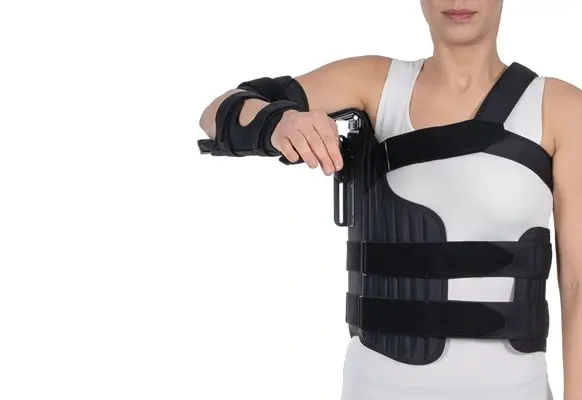
Aeroplane Splint
Features
- Adjustable Shoulder Abduction Positioning Across Multiple Angles
- Full Upper Limb Capture: Shoulder, Elbow, Wrist & Hand Support
- Indicated Across a Broad Spectrum of Shoulder & Neurological Conditions
- Lightweight Aluminium Framework with Polypropylene Shell Construction
- Hinge Joint at Axilla for Shoulder Movement & Drop Lock at Elbow
- Torso-Anchored Waist Band for Secure Structural Support
- Applicable for Both Paediatric & Adult Clinical Presentations
Aeroplane Splint Shoulder Abduction Orthosis for Brachial Plexus Injury, Erb's Palsy, Axillary Burn Contracture & Post-Operative Shoulder Rehabilitation
The Aeroplane Splint also known as the Shoulder Abduction Orthosis (SAO) or airplane splint is a purpose-engineered upper limb orthosis designed to position and maintain the shoulder joint in a prescribed degree of abduction away from the body, with the arm held out to the side at the clinician-determined angle that best serves the patient's specific clinical requirements. Named for the characteristic appearance created by the abducted arm positioning which resembles the outstretched wing of an aircraft the aeroplane splint is one of the most clinically established and widely prescribed devices in upper limb orthotics and post-operative shoulder rehabilitation, with a broad range of indications spanning neurological, orthopaedic, post-surgical, and burns management contexts.
The Clinical Rationale for Shoulder Abduction Positioning
The positioning of the shoulder in abduction serves several distinct and clinically important therapeutic purposes depending on the underlying condition being managed. In brachial plexus injury and Erb's palsy, shoulder abduction reduces the tensile loading on the injured nerve trunks by approximating the nerve's origin at the cervical spine with its distal distribution in the arm reducing the stretch-related mechanical stress that impairs axonal regeneration and functional recovery. Brachial plexus injury, rotator cuff injury, and shoulder subluxation are physically debilitating, with orthosis and patient compliance critical to improving functional outcomes positioning the aeroplane splint not merely as a passive support device but as an active therapeutic tool whose consistent use is directly linked to the quality of neurological and functional recovery achieved.
In post-operative shoulder management following rotator cuff repair, shoulder stabilisation procedures, nerve repair, tendon transfer, or shoulder arthroplasty, the aeroplane splint protects the surgical repair from the excessive tensile and compressive forces that would result from unsupported dependent arm positioning the posture that gravity naturally imposes on the limb when no orthotic support is provided. The aeroplane splint eliminates this gravitational stress by supporting the arm in the abducted position that places the least mechanical demand on the repaired structures, creating the protected mechanical environment that is the primary prerequisite for safe, uncomplicated surgical healing.
In axillary burn contracture management, shoulder abduction positioning is the single most important preventive and therapeutic intervention available. When burn wounds involving the axillary region heal, the resulting scar tissue undergoes a process of progressive contraction that draws the arm towards the body progressively reducing shoulder abduction range of motion until, in severe untreated cases, the arm becomes anchored against the chest wall in a position of near-complete adduction. The aeroplane splint, by maintaining the shoulder in maximum tolerated abduction throughout the healing and scar maturation period, directly opposes the contractile forces of the maturing scar preventing the loss of shoulder abduction range that would otherwise severely limit the patient's capacity for independence in activities of daily living.
Structural Design: How the Aeroplane Splint Functions
The mechanical architecture of the aeroplane splint is specifically engineered to solve a unique biomechanical challenge: supporting the full weight of the outstretched arm at a prescribed abduction angle, without placing the structural demands of this support on the injured shoulder itself. The solution lies in the torso-anchored waist band the padded circumferential strap that wraps around the patient's trunk and serves as the primary structural anchor from which the entire arm support assembly is suspended. By grounding the device on the stable, weight-tolerant structure of the trunk rather than on the vulnerable shoulder joint, the aeroplane splint transfers the gravitational load of the arm to the torso completely eliminating the dependent weight-bearing that would otherwise stress the shoulder joint, nerve repair, or surgical construct throughout the wearing period.
From this trunk anchor, the aluminium framework extends laterally and superiorly to support the arm trough at the prescribed abduction angle a rigid structural connection that maintains the abduction angle precisely regardless of the weight of the patient's arm or the gravitational forces acting on the device during movement. The arm and forearm troughs are padded with ethaflex foam or equivalent cushioning material, providing comfortable, pressure-distributing contact surfaces that support the limb without creating the localised bony prominence pressure that is the primary cause of skin complications with rigid upper limb orthoses during prolonged daily wear.
Adjustability: A Critical Clinical Feature
Traditional treatment of shoulder conditions involved use of aeroplane splints which provided fixed abduction at the shoulder joint a single-position approach that, while simple, imposes significant practical, social, and environmental restrictions on the patient and limits the clinician's ability to progress the treatment prescription as the patient's condition evolves. Modern aeroplane splint designs address this limitation through adjustable hinge systems at the shoulder and elbow joints, allowing the abduction angle to be advanced incrementally as the patient's range of motion improves, and the elbow position to be modified to accommodate different therapeutic requirements at different stages of rehabilitation.
The adjustable abduction mechanism is particularly important in axillary contracture management, where the clinical goal is progressive serial stretching of the contracted scar tissue a process that requires the splint to be routinely reset at the new maximum abduction angle achieved, maintaining a consistent end-range positional stretch that drives further scar elongation and range of motion improvement with each advancement. A simple self-adjustable aeroplane splint provides the patient with control over the splint's locking, unlocking, and adjustment, giving them a sense of freedom and self-reliance and the ability to quickly unlock and adduct the arm when negotiating narrow spaces, public transport, washrooms, and other real-world environments where the fully abducted position is impractical a feature that meaningfully improves wearability and long-term compliance.
Paediatric Application: Erb's Palsy & Brachial Plexus Birth Injuries
In paediatric practice, the aeroplane splint is the cornerstone of conservative and post-operative management for Erb's palsy the upper trunk brachial plexus birth injury that affects the C5 and C6 nerve roots and presents with characteristic weakness of shoulder abduction, external rotation, and elbow flexion. The aeroplane splint maintains the affected shoulder in the abducted, externally rotated position that reduces tension on the recovering nerve roots, prevents the internal rotation and adduction contracture that rapidly develops when the shoulder is left in its resting posture of adduction and internal rotation, and provides the supported limb positioning that allows nerve regeneration to proceed in the most favourable mechanical environment. Lightweight, universal designs specifically adapted for paediatric anatomy and growth accommodate the rapid changes in limb length and body size that occur during infancy and childhood, ensuring that the therapeutic positioning is accurately maintained as the child develops.
Post-Operative Wearing Schedule & Rehabilitation Integration
The duration and schedule of aeroplane splint use is determined by the treating surgeon and rehabilitation team based on the specific surgical procedure or clinical condition being managed. Following rotator cuff repair and shoulder stabilisation procedures, splinting is typically maintained continuously for four to six weeks, after which progressive mobilisation is introduced under physiotherapy supervision. In brachial plexus and Erb's palsy management, wearing schedules are individualised based on the degree of neurological recovery and the development of contracture risk. In axillary burn contracture management, the splint may be required for extended periods spanning months to years emphasising the importance of patient comfort, practical wearability, and compliance-supporting design features in this demanding indication.
Indicated For:
Brachial plexus injuries (upper, lower, and total), Erb's palsy (paediatric and adult), post-operative shoulder management following rotator cuff repair, shoulder stabilisation, nerve repair, tendon transfer, shoulder arthroplasty, and bone grafting; axillary burn contracture prevention and management; shoulder dislocation and subluxation; shoulder fusion and reconstruction; contracture prevention in neurological conditions affecting the upper limb; and pre- and post-operative positioning following soft tissue shoulder surgery.
Add your review
Your email address will not be published. Required fields are marked *
Please login to write review!
Looks like there are no reviews yet.

M. A. Medical Supports