
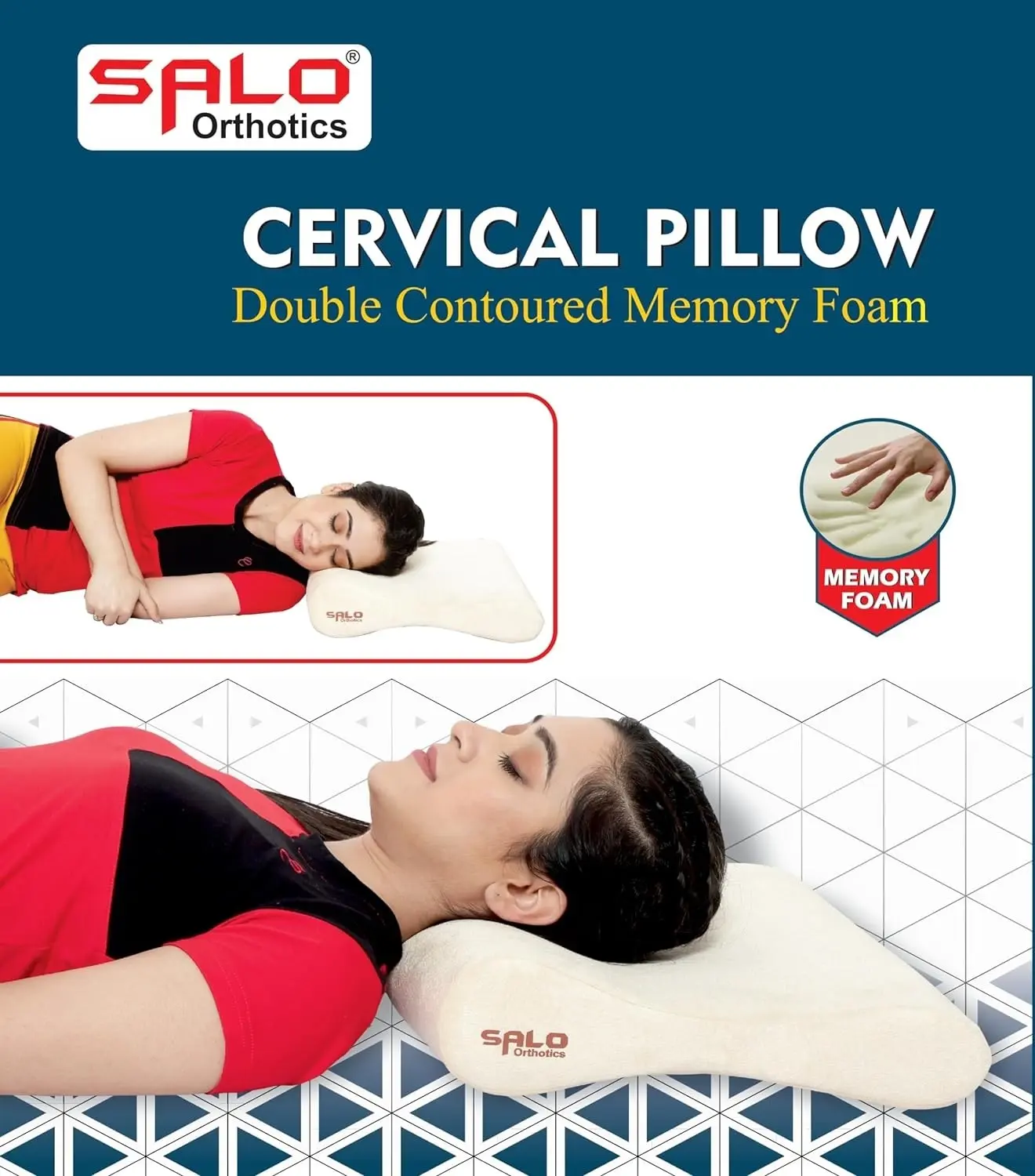
Cervical Pillow Double Contoured MEMORY FOAM
Features
- Slow-Rebound Viscoelastic Memory Foam for Personalised Cervical Contouring
- Double Contoured Dual-Lobe Design for Two Clinically Distinct Support Heights
- Restores the Natural Cervical Lordotic Curve to Relieve Neck Pain & Headaches
- Ergonomic Recessed Central Head Cradle for Stable, Pressure-Free Head Positioning
- Temperature-Regulating Memory Foam for Cool, Comfortable All-Night Sleep
- Clinically Recommended for Neck Injuries, Whiplash, Arthritis, Fibromyalgia & Cervical Spondylosis
- Removable, Breathable & Machine-Washable Hypoallergenic Cover for Long-Term Hygiene
Cervical Pillow Double Contoured Memory Foam Slow-Rebound Viscoelastic Neck Support Pillow for Cervical Lordosis Restoration, Personalised Anatomical Contouring & Superior Neck Pain Relief During Sleep
The Cervical Pillow Double Contoured Memory Foam represents the clinically superior evolution of the orthopedic cervical support pillow combining the evidence-supported corrective geometry of the double contoured design with the unique biomechanical properties of viscoelastic memory foam to deliver a sleep support system that is simultaneously anatomically precise, individually personalised, and therapeutically effective across a broader range of cervical spine conditions and sleeping positions than either standard contoured foam pillows or flat memory foam pillows can achieve in isolation.
The Clinical Superiority of Memory Foam in Cervical Support
The fundamental distinction between polyurethane foam and viscoelastic memory foam in cervical pillow design lies in how each material responds to the compressive load of the head during sleep and how that response translates into the quality of cervical support delivered across hours of nightly use. A solid memory foam pillow moulds around the contours of your head and neck, distributing weight evenly and reducing pressure points unlike traditional fibre or latex pillows, it does not spring back immediately but holds its shape to match yours throughout the night a material characteristic that produces a fundamentally different therapeutic outcome from standard foam.
While a standard PU foam cervical pillow maintains its pre-manufactured contoured shape regardless of the individual user's exact anatomical proportions providing a generalised corrective geometry that may fit well or less well depending on individual head weight, neck length, and cervical curve depth the memory foam cervical pillow actively conforms to the precise anatomical contours of each individual user. As the memory foam warms to body temperature at the contact zones, it softens and yields to the exact shape of the posterior occiput, the depth of the cervical lordotic curve, and the contour of the cervical facet and spinous process anatomy creating a bespoke support surface that is uniquely moulded to the individual rather than a generalised approximation of cervical anatomy. This personalised contouring distributes the compressive weight of the head across the broadest possible foam contact area, reducing peak contact pressures at bony prominences and maximising the proprioceptive comfort that enables the deep, restorative sleep in which cervical muscles fully relax and tissue healing proceeds most effectively.
The Double Contoured Profile: Engineering Two Support Solutions in One Pillow
The double contoured geometry of this memory foam cervical pillow addresses the most fundamental practical challenge in cervical pillow design the fact that back sleeping and side sleeping impose biomechanically distinct cervical support requirements that no single fixed-height pillow profile can optimally serve simultaneously. In back sleeping, the cervical spine must be supported at a relatively modest elevation sufficient to maintain the natural lordotic curve but not so high as to flex the neck into a forward chin-tuck posture that strains the posterior cervical ligaments and compresses the posterior intervertebral disc margins. In side sleeping, the pillow must bridge the significantly greater distance between the sleeping surface and the head a distance determined by the width of the shoulders to maintain horizontal spinal alignment, preventing the lateral cervical sag that compresses the downside facet joints and strains the upside cervical musculature.
Designed with dual heights, the cervical pillow provides correct sleeping posture for straight back sleep, use a low height pillow side, while for side sleep, use a high height pillow side the two contoured lobes of this pillow precisely address these different height requirements within a single reversible design. The user simply selects the lobe that corresponds to their primary sleep position, and the memory foam's personalised contouring system fine-tunes the support within that height range to the individual's exact anatomy producing a combined fixed-geometry plus personalised-contouring support system that is clinically more effective than either approach delivers independently.
Viscoelastic Properties & the Cervical Pain Relief Mechanism
The contoured memory foam cervical pillow restores the natural lordotic curve by elevating the head just enough so that the ears align vertically with the shoulders this reduces strain on the facet joints and prevents compression of the vertebral arteries identifying the two primary anatomical mechanisms through which cervical malalignment during sleep generates the neck pain, morning stiffness, and referred headache symptoms that are among the most prevalent quality-of-life complaints in the adult population. Facet joint loading is the most direct source of cervical pain from poor sleep posture when the cervical spine rests in a flexed, extended, or laterally deviated position during sleep, the inferior articular process of the superior vertebra compresses asymmetrically against the superior articular process of the inferior vertebra, generating the zygoapophyseal joint capsule stretch and synovial irritation that produces the characteristic posterior cervical pain and restricted morning range of motion that patients report after inadequately supported sleep.
The memory foam double contoured pillow addresses this mechanism by maintaining the cervical spine in the neutral lordotic position throughout sleep distributing facet joint loading symmetrically and at the minimal compressive forces that the recumbent posture allows. Simultaneously, the viscoelastic contouring around the posterior cervical musculature supports the soft tissue structures in a passively lengthened, relaxed state preventing the sustained isometric cervical muscle contraction that occurs when the neck must actively correct for an inadequate support surface, and allowing the profound muscular relaxation that is both the prerequisite for restorative sleep and the primary mechanism of nocturnal tissue healing in conditions of cervical muscle overuse and strain.
Memory Foam Certification & Material Safety
Made of high-density CertiPUR-US and Oeko-Tex certified slow rebound memory foam, which is non-toxic, odourless and keeps its shape and firmness for long-term use the CertiPUR-US and Oeko-Tex certifications of the memory foam used in this pillow are clinically important quality indicators for patients selecting a cervical support pillow for long-term therapeutic use. CertiPUR-US certification confirms that the foam has been tested and verified to be free from ozone depleters, heavy metals, formaldehyde, phthalates, and other hazardous chemical compounds that are associated with off-gassing, respiratory irritation, and skin sensitisation during prolonged direct contact. Oeko-Tex Standard 100 certification extends this material safety verification to the finished pillow product level confirming that all components of the pillow, including the foam, cover, and any adhesives or dyes, meet the stringent Oeko-Tex human ecological safety requirements for direct skin contact applications.
Clinical Conditions Most Responsive to Memory Foam Cervical Support
The clinical applicability of the double contoured memory foam cervical pillow is particularly pronounced in conditions where the anatomical variability between patients is greatest because the viscoelastic personalised contouring system accommodates this variability most effectively. In cervical spondylosis with osteophyte formation, the altered cervical anatomy creates unique support requirements that a fixed-geometry standard foam pillow cannot individually address the memory foam's ability to conform to the exact modified contours of the arthritic cervical spine provides support precisely calibrated to the individual's structural changes. In cervical disc herniation and radiculopathy, where specific segmental positioning is required to reduce foraminal compression and radicular symptom provocation during sleep, the memory foam contouring around the individual's particular cervical anatomy is more likely to achieve the exact positional requirements of the herniation level than a generalised geometric profile. In cervical post-surgical managementfollowing ACDF or posterior fusion, the memory foam's pressure-distributing properties reduce the risk of pressure-related complications at the incision site and bony fixation hardware locations during the healing period.
Practical Considerations: Adjustment Period, Temperature Sensitivity & Initial Odour
Users transitioning to the double contoured memory foam cervical pillow from conventional pillows should be aware of several product characteristics that are inherent to viscoelastic memory foam and that affect the initial user experience. A brief adjustment period of one to three weeks is expected as the cervical musculature and ligamentous structures adapt to the corrective positioning during this period, alternating between the memory foam cervical pillow and a conventional pillow on successive nights is clinically recommended to allow gradual adaptation without generating the muscular soreness that abrupt full-time adoption can produce. The memory foam's temperature sensitivity the property that enables its personalised contouring function means that the pillow may feel firmer in cold room environments and softer in warm ones, a characteristic that typically diminishes in significance as the pillow warms to body temperature within the first few minutes of contact.
Memory foam can retain heat, which may be uncomfortable for warm sleepers look for open-cell or gel-infused versions users who are naturally warm sleepers or who live in hot climates should select a double contoured memory foam cervical pillow with open-cell foam construction or gel infusion, as these modifications to the standard viscoelastic foam formulation significantly enhance heat dissipation and maintain a cooler sleeping surface temperature throughout the night. The initial off-gassing odour that is characteristic of new memory foam products typically dissipates within 24 to 48 hours of airing the pillow outside its packaging a normal material property that does not indicate any chemical hazard and has no effect on the pillow's therapeutic performance.
Indicated For:
Cervical hypolordosis and flat neck syndrome, cervical spondylosis and facet joint arthropathy, cervicogenic headache and suboccipital neuralgia, whiplash-associated disorders, fibromyalgia with cervical involvement, cervical disc herniation and radiculopathy, chronic cervicalgia and neck muscle tension, post-operative cervical spine management following ACDF and posterior fusion, rheumatoid arthritis cervical involvement, atlantoaxial instability conservative management, ankylosing spondylitis cervical phase, torticollis conservative management, cervical stenosis symptomatic management, shoulder bursitis with cervical contribution, and any individual seeking evidence-aligned personalised orthopedic cervical sleep support for the prevention or management of neck pain, morning stiffness, cervicogenic headache, and sleep-related cervical musculoskeletal dysfunction.
Add your review
Your email address will not be published. Required fields are marked *
Please login to write review!
Looks like there are no reviews yet.

M. A. Medical Supports