
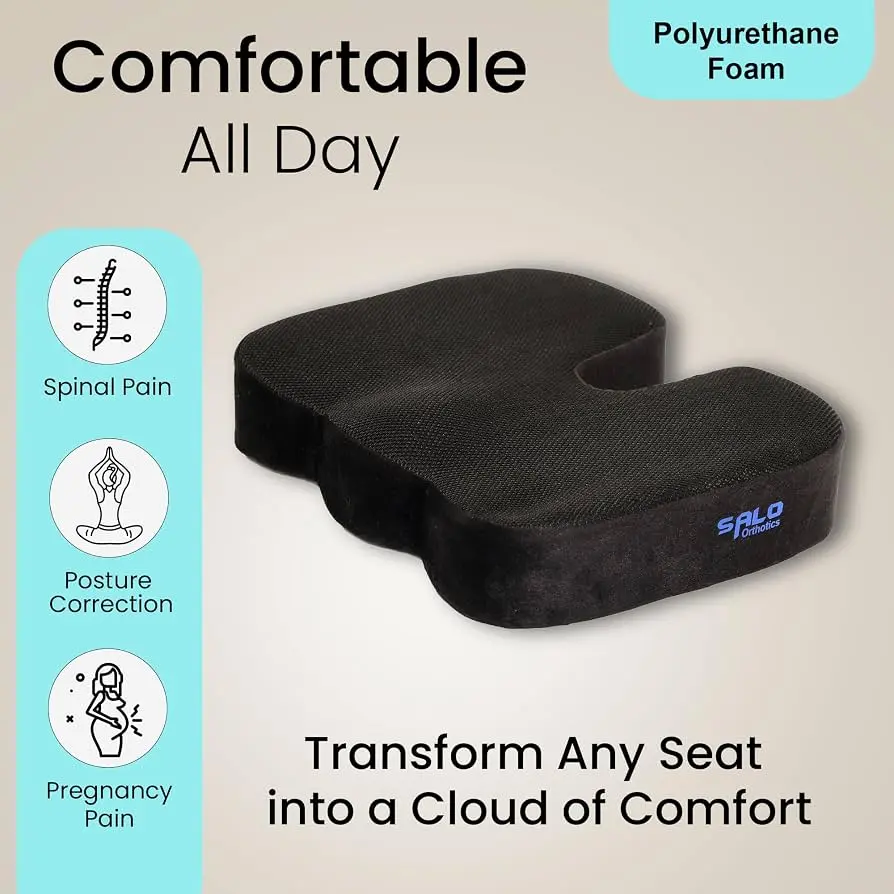
Coccyx Cushion PU Foam - Butterfly
Features
- Distinctive Butterfly Profile for Bilateral Hip Support & Central Coccyx Suspension
- Central Vacuum Cutout for Complete Coccyx, Sacral & Perineal Pressure Elimination
- Quality PU Foam with Air Ventilation Pores for Breathable, Durable Support
- Wedge-Angle Design for Anterior Pelvic Tilt & Natural Lumbar Lordosis Restoration
- Clinically Indicated for Coccydynia, Sciatica, Piles, Post-Natal & Post-Surgical Recovery
- Non-Slip Base & Carry Strap for Stable Positioning & Effortless Portability
- Removable, Machine-Washable Breathable Cover for Long-Term Hygiene & Freshness
Butterfly Coccyx Cushion PU Foam Orthopedic Butterfly-Shaped Tailbone Seat Cushion for Coccydynia, Sciatica, Piles, Post-Natal Recovery & Prolonged Seated Comfort
The (Butterfly) Coccyx Cushion PU Foam is a clinically designed, ergonomically advanced orthopedic seat cushion whose distinctive butterfly-shaped profile represents a significant evolution in tailbone pain relief seat cushion design. By combining the coccyx pressure elimination of a central vacuum cutout with the bilateral symmetrical weight distribution of extended butterfly wing support zones, the wedge-assisted pelvic positioning of an angled foam base, and the breathable durability of premium PU foam with air ventilation pores, the Butterfly Coccyx Cushion delivers a comprehensively engineered seated pain relief and postural correction solution that outperforms conventional U-shaped and donut coccyx cushions across both biomechanical effectiveness and practical daily usability.
The Butterfly Shape: A Clinically Superior Coccyx Cushion Architecture
The fundamental biomechanical advantage of the butterfly coccyx cushion over conventional U-shaped and donut coccyx cushion designs lies in its symmetric bilateral wing geometry the two wing-shaped lateral extensions that project outward from the central cutout zone to create a broad, bilaterally balanced weight-bearing surface that more closely resembles the natural contact geometry of the human ischial tuberosity pair than either the narrow rear-opening U-shape or the central hole of the donut design.
The unique butterfly-shaped seat cushion evenly distributes body weight, improves posture, and helps reduce pressure on the lower back for greater comfort during long sitting periods the bilateral symmetry of the butterfly wing profile achieves this even weight distribution by providing equal, proportionate support contact on both sides of the pelvic girdle simultaneously, preventing the subtle lateral tilt and asymmetric pelvic loading that can develop when the seat cushion contact geometry is wider on one side than the other. In individuals who already have pre-existing pelvic asymmetry, leg length discrepancy, or scoliotic spinal curvature, this symmetric bilateral support is particularly clinically valuable maintaining the most even possible pelvic seating platform despite underlying anatomical asymmetry.
PU Foam Construction: The Clinical Case for Polyurethane Over Memory Foam in Coccyx Cushions
The choice of polyurethane foam as the primary construction material of the Butterfly Coccyx Cushion reflects a considered material selection that prioritises specific properties most relevant to effective coccyx cushion performance. Coccyx cushions are commonly made from materials such as PU foam, memory foam, or gel-infused foam the goal is simple: comfort without collapse and support without stiffness and PU foam occupies a clinically appropriate middle ground between the softer, heat-conforming properties of memory foam and the firmer, more temperature-stable properties of high-density structural foams.
The air ventilation pores integrated throughout the PU foam core of the butterfly coccyx cushion significantly enhance the material's already adequate breathability creating a network of microscopic air channels through the foam matrix that promote continuous airflow between the seating surface and the seat beneath, continuously dissipating the body heat that accumulates at the posterior pelvis-to-cushion interface during extended seated use. This ventilation system addresses one of the most consistent user complaints about foam seat cushions during prolonged daily use the progressive heat build-up and perspiration that develop at the contact zone maintaining a cooler, drier, more comfortable seated microclimate throughout the full working day, extended driving session, or wheelchair use period.
The Central Vacuum Cutout: Engineering Complete Pelvic Floor Decompression
The terminology of "vacuum cutout" as opposed to simply "cutout" reflects a specific design characteristic of the butterfly coccyx cushion's central relief zone the cutout is designed to create a completely pressure-free, air-filled space beneath the coccyx, sacrum, and perineum that functions as a genuine decompression chamber rather than merely a reduced-pressure zone. The specially designed vacuum in the centre relieves pressure thereby reduces lower back pain enables painless sitting without direct pressure on the episiotomy stitches, haemorrhoid or inflamed coccyx the vacuum cutout eliminates all contact between the seating surface and the anatomical structures it overlies, including the coccyx, the lower sacrum, the anococcygeal ligament, the perineal body, and the external anal sphincter creating a seated environment in which all of these sensitive anatomical structures are simultaneously decompressed and protected from the mechanical trauma of direct contact pressure throughout every hour of seated activity.
This comprehensive pelvic floor decompression capability is what distinguishes the butterfly coccyx cushion from standard lumbar or seat cushions that reduce coccygeal pressure as a secondary benefit of general weight redistribution the butterfly coccyx cushion makes complete pelvic floor decompression its primary design objective, with the bilateral wing support zones, wedge angle, and ventilated PU foam construction all serving this central therapeutic goal.
The Wedge Base: Restoring the Lumbar Lordosis as Part of Coccyx Pain Management
An important and frequently under-appreciated component of comprehensive coccyx pain management is the restoration of correct lumbar spinal alignment during seated use a therapeutic objective that the butterfly coccyx cushion's wedge-angled base directly addresses. When an individual suffering from coccydynia sits on a flat surface, the pain response frequently drives them to adopt a forward-leaning posture or a posterior pelvic tilt that they believe reduces coccygeal contact but that in reality increases the posterior loading on the sacrococcygeal junction and simultaneously flattens the lumbar lordosis, generating secondary lower back muscle tension and intervertebral disc loading that compound the primary coccygeal pain with an additional lumbar pain component.
The angle of this pillow can help restore the lumbar curve in your spine while rotating your pelvis which reduces strain on the lower spine designed to position the hips for better posture and alignment the wedge base's posterior elevation simultaneously achieves two therapeutic objectives: it tilts the entire pelvis anteriorly, lifting the coccyx clear of the seat surface and reducing sacrococcygeal contact pressure; and it restores the natural anterior lumbar lordosis, reducing the disc and posterior element loading that the flat-sitting compensatory posture otherwise generates. This dual-mechanism action makes the butterfly coccyx cushion's therapeutic effect on lower back pain substantially more comprehensive than a simple cutout cushion without a wedge base.
Haemorrhoids, Piles & Perianal Conditions: Targeted Perineal Relief
The butterfly coccyx cushion's central vacuum cutout provides clinically important relief for perianal and perineal conditions that make sitting acutely painful conditions that, while anatomically distinct from coccydynia, share the common therapeutic requirement of eliminating direct contact pressure at the perianal and perineal region during seated activities. Helpful to piles patients due to contoured wedged shape enables painless sitting without direct pressure on the episiotomy stitches, haemorrhoid or inflamed coccyx for haemorrhoid and piles patients, the vacuum cutout eliminates the compressive and shearing forces at the anal verge that standard flat seating generates forces that cause haemorrhoidal bleeding, prolapse aggravation, and perianal pain during the prolonged sitting of desk work and driving. The relief provided by the butterfly coccyx cushion in this context is immediate, meaningful, and often dramatically transformative for patients who had been significantly limiting their daily seated activities to avoid haemorrhoidal pain provocation.
Post-Natal Applications: Maternal Recovery & Breastfeeding Comfort
The post-natal period is among the most clinically significant indications for the butterfly coccyx cushion — combining perineal tissue trauma from childbirth with the coccygeal stress of prolonged labour and delivery, creating a multi-source seated pain presentation that makes the early weeks of new motherhood acutely uncomfortable during the sustained seated activities that breastfeeding and infant care demand. The butterfly coccyx cushion's complete perineal decompression through the central vacuum cutout eliminates direct contact pressure at episiotomy repair sites, perineal tears, and inflamed coccygeal structures simultaneously, providing the seated comfort that allows new mothers to maintain the breastfeeding positions, skin-to-skin contact time, and infant care activities that are essential during the early post-natal period without the seated pain that unmodified flat seating generates.
Post-Surgical Recovery: Protecting Surgical Sites During Seated Rehabilitation
Following surgical procedures involving the perianal region, pelvis, or coccyx including haemorrhoidectomy, pilonidal cyst excision, perianal fistula repair, coccygectomy, prostatectomy, and gynaecological procedures the butterfly coccyx cushion provides the protected seated environment that allows patients to return to seated activities during the rehabilitation period without exposing the surgical site to the mechanical trauma of direct contact pressure. An orthopaedic medical seat pillow used to provide support or pain relief in broken, injured and fractured tailbone, coccygeal, sacrum, chronic sciatica, nerve, coccygectomy and spinal cord conditions the comprehensive clinical scope of post-surgical application reflects the butterfly coccyx cushion's capacity to protect virtually any sensitive perianal or sacrococcygeal surgical site from seated mechanical disruption during the healing and rehabilitation phase.
Universal Seated Compatibility & Practical Daily Management
The butterfly coccyx cushion's compact dimensions, non-slip base, and carry strap make it immediately compatible with and portable across the full range of seated environments office chairs, executive chairs, gaming chairs, car seats, wheelchair seating, aircraft seats, stadium and bleacher seating, home sofas, and wooden dining chairs ensuring that the therapeutic coccyx pressure relief and postural correction the cushion provides are available consistently across every seated context rather than only at the primary home or office workstation. The removable, machine-washable cover maintains hygienic standards throughout months of daily use a particularly important practical feature in post-surgical and post-natal applications where the hygiene of the seating interface is directly relevant to wound healing and infection prevention.
Indicated For:
Coccydynia (tailbone pain) from trauma, fracture, bruising, and hypermobility, haemorrhoids and piles perianal pain relief, post-natal perineal recovery including episiotomy and perineal tear healing, post-haemorrhoidectomy and post-pilonidal cyst excision seated protection, post-prostatectomy and post-gynaecological surgery perineal decompression, coccygectomy post-operative rehabilitation, sitting-aggravated sciatica and lumbar radiculopathy, prolonged desk work and occupational seated lower back pain, wheelchair seating pressure relief and skin protection, pelvic floor disorders with seated pain, piriformis syndrome, and any condition requiring complete pressure elimination at the coccygeal, sacral, or perineal anatomical region during seated daily activities.
Add your review
Your email address will not be published. Required fields are marked *
Please login to write review!
Looks like there are no reviews yet.

M. A. Medical Supports