
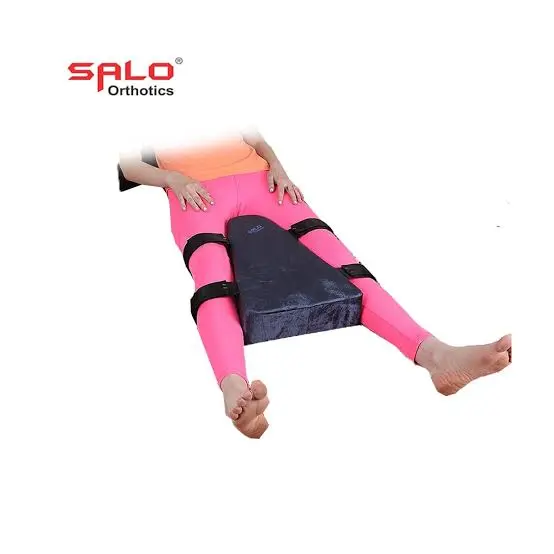
Hip Abduction Pillow
Features
- Clinically Designed to Prevent Post-Operative Hip Dislocation
- Trapezoidal Wedge Structure Maintains Safe 15° Hip Abduction Angle
- Dual Concave Leg Channels for Anatomically Contoured Limb Support
- Adjustable Hook-and-Loop Securing Straps for Stable All-Night Positioning
- Suitable for Supine & Side-Lying Positioning in Bed & Wheelchair Use
- Medium-Density Foam Construction for Firm, Shape-Retaining Positional Control
- Latex-Free, Skin-Safe & Compatible with Post-Operative Wound Dressings
Hip Abduction Pillow Foam Wedge Leg Separator for Post-Hip Replacement Dislocation Prevention, Hip Fracture Management & Neurological Lower Limb Positioning
The Hip Abduction Pillow is a clinically essential positioning device designed to maintain the lower limbs in a prescribed abducted position legs separated, apart from each other during the critical post-operative recovery period following total hip replacement (arthroplasty), hip fracture repair, and other hip surgical procedures in which the restored or reconstructed hip joint must be protected from the adduction and internal rotation movements that constitute the primary mechanical dislocation pathway. A hip abduction pillow helps prevent your hip from turning in or away from your body it will also keep your hip straight while you are in bed, even while you are asleep the abduction pillow will hold your hip in one position and help it heal fulfilling the fundamental clinical requirement of post-hip-surgery care: reliable, passive, continuous maintenance of the operated hip in its safest biomechanical position throughout the full recovery period, particularly during sleep when voluntary positional awareness and protective muscle activation are absent.
The Clinical Imperative: Why Hip Dislocation Is the Primary Post-Operative Risk
Total hip replacement one of the most frequently performed and clinically successful elective orthopaedic procedures worldwide restores pain-free hip function by replacing the arthritic or damaged femoral head and acetabular socket with precision-engineered prosthetic components. The immediate post-operative period, however, is characterised by a specific and serious complication risk: prosthetic hip dislocation the displacement of the prosthetic femoral head from the acetabular cup which occurs in approximately 1% to 3% of primary total hip arthroplasties and which requires either urgent closed reduction under anaesthesia or, in recurrent cases, return to the operating theatre for revision surgery.
An abductor wedge is designed to separate the legs of a patient it is often used after hip surgery to prevent the new hip from popping out the dislocation risk is highest in the immediate post-operative period before the periarticular soft tissue envelope the hip capsule, short external rotators, and gluteal musculature has healed sufficiently to provide passive restraint to the prosthetic joint. During this vulnerable period, specific movements cross the safe boundary of prosthetic hip stability: adduction (bringing the operated leg across the midline), internal rotation (turning the foot inward), and combined hip flexion beyond 90 degrees the movement combinations that most commonly produce dislocation in the posterior surgical approach population. The hip abduction pillow prevents the most dangerous of these movements adduction by maintaining a physical separation between the thighs that cannot be overcome during inadvertent sleep movement, regardless of the patient's conscious awareness or voluntary motor control.
The Trapezoidal Wedge Geometry: Engineering Stability at the Prescribed Angle
The trapezoidal cross-section of the hip abduction pillow is the engineering solution to the specific biomechanical challenge of maintaining a consistent inter-thigh separation at a clinically prescribed angle against the variable, unpredictable forces of patient movement during sleep. The trapezoidal form wider at the base and narrower at the top creates a mechanically stable wedge that locks into the inter-thigh space without the tendency to rotate, slide, or eject that a simple rectangular block would develop as the patient shifts position during sleep. Our leg pillow keeps lower limbs abducted 15° and stays in a safe and stable position for optimal healing and pain relief trapezoidal structure maintains a comfortable angle of abduction the 15-degree abduction angle maintained by this geometry is the clinically validated minimum separation required to prevent the cross-midline adduction that constitutes the primary dislocation mechanism, without exceeding the abduction range that would generate perineal pressure, hip abductor tension, and patient discomfort during the overnight wearing periods.
The Dual Concave Leg Channels: Anatomical Compatibility for Sustained Wearing Comfort
The bilateral concave channels sculpted into the lateral thigh contact surfaces of the hip abduction pillow represent one of its most practically important design refinements the feature that determines whether a patient tolerates the pillow consistently through the night or removes it due to discomfort, and therefore whether the prescribed dislocation protection is actually delivered. A flat-sided wedge placed between the thighs contacts the leg surface only at the medial edges of the wedge concentrating the entire wedge-reaction force across two narrow lines of contact at the medial femoral condyle and distal thigh regions. Over the course of a full night's sleep, this concentrated linear loading generates the localised pressure, numbness, and discomfort that cause patients to remove the pillow a clinical compliance failure with direct patient safety implications.
Dual concave side fits the contour of the leg for added comfort the concave channels of the hip abduction pillow resolve this problem by conforming to the cylindrical anatomy of each thigh, distributing the wedge-reaction forces broadly across the full medial and posterior thigh surface in bilateral contact with the pillow. This broad, anatomically matched contact distribution reduces peak pressure at any single anatomical location to levels that are comfortable throughout the night supporting the sustained, uninterrupted wearing compliance that the prescribed dislocation protection requires and that represents the single most important determinant of the hip abduction pillow's clinical effectiveness in the post-operative setting.
The Securing Strap System: Transforming Positioning into Active Protection
The adjustable hook-and-loop securing straps are the component that fundamentally distinguishes the hip abduction pillow from simply placing a domestic pillow or folded blanket between the legs the solution that many patients attempt and that consistently fails to maintain adequate inter-limb separation during sleep. Two hook and loop straps adjust to fit the legs and secure the position the straps wrap around both thighs and the interposed wedge pillow, creating an integrated positional constraint system that maintains the prescribed abduction angle as a single, mechanically stable unit rather than as three separate components that can separate and migrate independently during patient movement.
The independent adjustability of each strap to each thigh is clinically important in post-hip-replacement patients, who frequently have asymmetric thigh circumferences the operated limb often having greater swelling in the immediate post-operative period and who may be wearing compression stockings, wound dressings, or drain sites on the operated leg that alter the effective thigh dimensions and require strap accommodation. The hook-and-loop closure system enables the night nurse, carer, or patient to adjust each strap independently to the exact tension that maintains secure positioning without generating circumferential thigh compression that would impair venous return a particularly important consideration in the post-operative period when deep vein thrombosis prophylaxis is a primary clinical priority.
Post-Hip Replacement: The Primary Surgical Indication
You may need to wear a hip abduction pillow if your hip moved out of the joint or you have a hip fracture it may also be used after surgery such as an open reduction and internal fixation (ORIF) or a hip arthroplasty you may need to use a hip abduction pillow for several weeks the post-total hip arthroplasty indication is the most prevalent and clinically most critical application of the hip abduction pillow. Following posterior approach total hip replacement the most commonly used surgical approach the posterior capsule and short external rotators are divided to access the hip joint and are repaired at the conclusion of the procedure. During the healing period of this repair typically six to twelve weeks the posterior soft tissue restraints are insufficient to independently prevent dislocation if the hip is subjected to the combination of flexion, adduction, and internal rotation that constitutes the posterior dislocation pathway. The hip abduction pillow specifically prevents the adduction component of this dislocation triad throughout the entire overnight sleeping period the most vulnerable period of the 24-hour day for dislocation risk.
Hip Fracture Repair & ORIF: Secondary but Equally Critical Indications
Following surgical repair of hip fractures including femoral neck fractures managed with cannulated screw fixation or hemiarthroplasty, and intertrochanteric fractures managed with dynamic hip screw or intramedullary nail fixation the hip abduction pillow serves a similar dislocation prevention function when hemiarthroplasty has been performed, and an additional function of maintaining the fracture repair in correct alignment by preventing the adduction forces that could displace the fixation construct during the early healing period. In ORIF of acetabular fractures where the stability of the reconstructed acetabulum and the reduction of the femoral head are the primary post-operative maintenance objectives — the hip abduction pillow prevents the adduction and internal rotation that would stress the acetabular fixation and potentially displace the reduction before bony union has occurred.
Neurological & Wheelchair Applications: Contracture Prevention & Spasticity Management
The abductor wedge can also be used to support the legs of an individual with spinal cord injury or severe physical or neurological disabilities in abduction (legs apart position) while seated in a wheelchair beyond the post-surgical orthopaedic context, the hip abduction pillow has a clinically important application in the management of neurological conditions characterised by lower limb adductor spasticity including spinal cord injury, cerebral palsy, multiple sclerosis, and acquired brain injury where the unopposed activity of the adductor musculature progressively drives the legs into the adducted, internally rotated posture that, if sustained without orthotic correction, leads to hip adduction contracture, perineal hygiene difficulties, pressure ulcer development at the medial knee and ankle contact zones, and the seated instability that impairs wheelchair propulsion and transfer performance. The abduction pillow prevents contractures, increases circulation, prevents oedema and generally prevents hip dislocation after hip surgery the contracture prevention, circulation improvement, and oedema reduction benefits identified in this clinical description reflect the comprehensive secondary benefits of maintained lower limb abduction positioning that accrue across the full neurological indication spectrum as well as the post-surgical population.
Post-Hip Dysplasia Treatment: Maintaining Corrective Reduction
In paediatric and adult hip dysplasia management where surgical or conservative reduction of the dysplastic hip is followed by a period of maintained abduction positioning to promote acetabular development around the newly reduced femoral head the hip abduction pillow provides the sustained passive abduction force that prevents the relapse of the femoral head into the dysplastic, subluxed position during the recumbent positioning period. Abduction wedges are primarily used for patients who have undergone hip surgery, such as total hip replacement (arthroplasty) or hip fracture repair they are also used in cases of hip dysplasia or other conditions requiring the legs to be kept in a specific position the hip dysplasia indication encompasses both the immediate post-reduction period, where maintained abduction is critical to preventing re-subluxation before capsular healing, and the developmental monitoring period, where periodic abduction positioning supports the ongoing acetabular remodelling that is the therapeutic goal of dysplasia management.
Practical Guidance: Application, Positioning & Nursing Care
The best position to sleep after hip replacement is on your back with an abductor pillow between the legs make sure to avoid crossing your ankles or legs to protect your replaced hip while sleeping. The hip abduction pillow should be placed between the thighs with the wider base positioned at the groin level and the narrower upper portion between the knees, with both securing straps wrapped around each thigh and fastened at the tension that maintains firm contact without circulatory compression. The night nurse or carer should verify correct positioning and strap tension at each care contact during the inpatient period, and the patient or home carer should be instructed in independent daily application and removal for the home recovery phase.
The cushioning provided by an abduction pillow also helps reduce pain and swelling in the affected area, promoting faster recovery and improved mobility for patients undergoing hip surgery the pain and swelling reduction benefits of the abduction pillow operate through the maintenance of the optimal hip joint alignment that minimises pericapsular soft tissue tension and reduces the inflammatory joint loading that generates post-operative hip pain contributing to the overall pain management strategy and potentially reducing analgesic requirements during the early post-operative recovery period.
Indicated For:
Post-total hip arthroplasty (THA) dislocation prevention posterior, lateral, and anterolateral approach, post-hip fracture repair including hemiarthroplasty, cannulated screw fixation, dynamic hip screw and intramedullary nail fixation, post-acetabular fracture ORIF positioning, post-hip dysplasia reduction positioning and acetabular development support, hip dislocation closed or open reduction post-care, spinal cord injury lower limb adductor spasticity and contracture prevention in wheelchair and recumbent positioning, cerebral palsy hip adduction contracture management, multiple sclerosis lower limb positioning, acquired brain injury lower limb spasticity positioning, and any clinical presentation requiring maintained passive lower limb abduction positioning during recumbent or wheelchair-seated periods to prevent adduction-pathway hip dislocation, contracture formation, or surgical fixation displacement.
Add your review
Your email address will not be published. Required fields are marked *
Please login to write review!
Looks like there are no reviews yet.

M. A. Medical Supports