
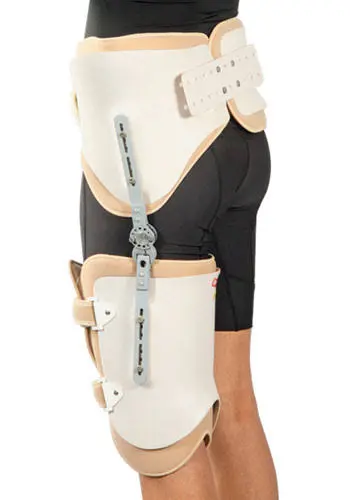
Hip Abduction Splint
Features
- Rigid Pelvic Band & Thigh Cuff Construction for Precise, Clinician-Controlled Abduction Positioning
- Adjustable Hip Joint Hinge for Independently Controlled Flexion & Abduction Range
- Clinically Indicated for Developmental Dysplasia of the Hip (DDH) in Infants & Children
- Post-Hip Replacement & Post-Surgical Dislocation Prevention
- Neurological Applications: Cerebral Palsy, Spinal Cord Injury & Spasticity Management
- Open Design for Diaper Access, Hygiene Maintenance & Skin Monitoring
- Adjustable Sizing for Paediatric Through Adult Clinical Applications
Hip Abduction Splint Rigid Hip Abduction Orthosis for Developmental Hip Dysplasia, Post-Surgical Dislocation Prevention, Cerebral Palsy & Neurological Lower Limb Management
The Hip Abduction Splint is a clinically designed, structurally rigid hip orthosis engineered to maintain the hip joint in a precisely prescribed position of abduction the position in which the femoral head is most congruently and stably seated within the acetabular socket through a pelvic band, thigh cuff, and connecting lateral upright structural system that delivers a level of positional control, angular precision, and movement resistance that soft foam abduction pillows and fabric harness systems cannot provide. Applicable across the full spectrum of clinical presentations requiring controlled hip abduction from the neonatal period of developmental hip dysplasia management through post-surgical adult hip replacement dislocation prevention and neurological lower limb spasticity management the hip abduction splint is the orthotic device of choice when the clinical requirement for precise, reliable, and durable hip abduction positioning cannot be met by less structurally robust alternatives.
Understanding Hip Abduction as a Therapeutic Principle
The hip joint — the largest and most mechanically loaded joint in the human body is a ball-and-socket articulation between the spherical femoral head and the cup-shaped acetabulum of the pelvis. The stability of this articulation depends on the congruent, concentric relationship between these two bony surfaces a relationship that is maintained in health by the combined action of the articular geometry, the joint capsule, the labrum, and the periarticular musculature. When this congruent relationship is disrupted whether by developmental acetabular maldevelopment in DDH, by surgical disruption of the posterior capsule and external rotators during hip replacement, or by the muscle imbalance of neurological spasticity the femoral head is vulnerable to displacement from the acetabulum in directions determined by the biomechanical forces acting on the hip during daily activities.
Hip abduction moving the leg away from the body's midline positions the femoral head in its deepest, most congruent seating within the acetabulum, maximising the contact area between the femoral head and acetabular articular surfaces and reducing the concentration of compressive loading at any single point of articular contact. In DDH, abduction places the femoral head directly over the developing acetabular socket, promoting the pressure-mediated acetabular remodelling that drives the formation of a deeper, more stable acetabular cup. In post-hip replacement management, abduction prevents the cross-midline adduction that is the primary displacement mechanism for prosthetic femoral head dislocation from the posterior acetabular rim. In neurological spasticity, maintained abduction counteracts the adductor hypertonicity that progressively displaces the femoral head laterally and superiorly out of the acetabulum in the direction of hip subluxation.
Developmental Dysplasia of the Hip: The Primary Paediatric Indication
Developmental dysplasia of the hip (DDH) formerly known as congenital dislocation of the hip encompasses a spectrum of hip disorders ranging from mild acetabular underdevelopment without femoral head displacement through complete dislocation in which the femoral head is entirely outside the acetabulum. It is among the most common congenital musculoskeletal conditions, with an incidence varying between 1.5 and 20 per 1000 live births depending on the diagnostic criteria and screening method used and its prompt recognition and appropriate treatment are critical to preventing the long-term morbidity of chronic pain, early osteoarthritis, gait abnormalities, and leg length discrepancy that established untreated dysplasia produces.
The primary therapeutic principle in DDH management across all aetiologies and severity grades is the maintenance of concentric reduction the restoration and sustained maintenance of the femoral head in its correct, centred position within the acetabulum which provides the mechanical stimulus for acetabular socket development through pressure-mediated cartilaginous remodelling during the plastic, growth-responsive period of early skeletal development. Paediatric hip abduction splints maintain concentric reduction of hips in patients with hip dysplasia this orthotic design replaces spica casts and harnesses for some presentations of neuromuscular and developmental hip dysplasia the one-piece polypropylene orthosis holds the infant in 90 degrees of hip flexion and 60 degrees of hip abduction reflecting the clinically validated positional prescription for optimal femoral head centring and acetabular stimulation across the DDH treatment literature.
The clinical evidence supporting abduction splint treatment of DDH is well-established the abduction brace allowed reduction in 85% of patients across Graf types IIa, IIb, and IIc achieving clinical outcomes comparable to the Pavlik harness in these presentations while offering the important additional advantage of a rigid structural framework that maintains the prescribed abduction angle more reliably than the flexible fabric straps of the harness system during the active movements, leg kicking, and caregiver handling of the infant's daily care routine. The splints were worn part-time, at night, for two months following initial full-time wearing reflecting the standard progressive wearing schedule reduction that mirrors the clinical response to treatment and the maturing stability of the hip as acetabular development proceeds.
Post-Hip Replacement: Adult Surgical Dislocation Prevention
Following total hip arthroplasty particularly via the posterior surgical approach in which the posterior capsule and short external rotators are divided and subsequently repaired the immediate and early post-operative period is characterised by a specific and serious risk of prosthetic femoral head dislocation. The hip abduction splint provides the mechanical dislocation protection required during this vulnerable period by maintaining the operated hip in the abducted position preventing the adduction and internal rotation movements that constitute the posterior dislocation pathway through a structural framework that actively resists these movements regardless of the forces generated by patient repositioning, unconscious sleep movement, or carer-assisted transfers.
A post-operative hip abduction orthosis for preventing hip dislocation during recovery comprising a pelvic support, a thigh cuff, and a vertically extending hip supporting brace with adjustable stops for controlling the angular range of motion the hip abduction splint's adjustable range-of-motion stops allow the operating surgeon to prescribe the specific motion limits appropriate for each patient's surgical procedure, approach, and implant stability setting a minimum abduction angle that prevents dislocation risk while permitting the flexion range required for transfers, seating, and early mobilisation within the protective orthotic framework.
Cerebral Palsy: Progressive Hip Displacement Prevention
In cerebral palsy where spastic diplegia and quadriplegia are characterised by progressive hip adductor and flexor spasticity that drives the femoral head laterally and superiorly out of the acetabulum the hip abduction splint provides the most mechanically robust available orthotic intervention for preventing the progressive hip migration index increase that, left unmanaged, leads to painful hip subluxation and dislocation requiring salvage osteotomy or femoral head resection procedures.
A sitting hip, walking hip, standing hip (SWASH) brace for cerebral palsy orthosis with a pelvic wrap, rods, and mid-thigh cuffs designed to prevent hip dislocation experimental group would wear hip protection orthosis over 12 hours a day for one year the clinical trial evidence for hip abduction orthosis use in cerebral palsy demonstrates that consistent daily use significantly reduces the migration index and improves the range of motion of the hip joint, representing a clinically meaningful intervention for delaying or preventing the hip dislocation that represents one of the most serious and painful orthopaedic complications of severe cerebral palsy.
The hip abduction splint's rigid structural framework generates a passive abduction force that directly counteracts the adductor spasticity driving hip migration not by attempting to overcome the dynamic component of spasticity during active muscle contraction, but by consistently maintaining the biomechanical environment of hip abduction that prevents progressive displacement during the prolonged daily periods of sitting, recumbent positioning, and sleep in which the cumulative effect of unopposed adductor tone drives the migration process.
Spinal Cord Injury & Wheelchair Positioning
The abductor wedge can also be used to support the legs of an individual with spinal cord injury or severe physical or neurological disabilities in abduction (legs apart position) while seated in a wheelchair in spinal cord injury, the combination of lower limb paralysis, altered muscle tone, and prolonged wheelchair sitting creates a hip adduction posture that can be both cosmetically distressing and functionally limiting, generating medial knee and ankle contact pressure, perineal hygiene difficulties, and progressive hip adduction contracture. The hip abduction splint particularly in its wheelchair-adapted configurations with a detachable central divider and pelvic wrap provides consistent passive abduction positioning during wheelchair sitting that prevents adduction contracture formation, improves perineal hygiene access, maintains bilateral leg symmetry, and reduces the medial leg contact pressure that contributes to skin breakdown in insensate lower limbs.
Legg-Calvé-Perthes Disease: Containment Orthosis Application
In Legg-Calvé-Perthes disease the avascular necrosis of the femoral head in children aged four to ten years that, if not managed with appropriate containment to prevent femoral head deformation during the revascularisation and reossification phase, leads to aspherical femoral head remodelling and early hip osteoarthritis the hip abduction splint in its ambulatory configuration (Scottish Rite orthosis) provides the femoral head containment required to maintain the softened, vulnerable femoral head within the acetabular mould during weight-bearing activities. Scottish Rite orthosis: pelvic band, bilateral free-motion hip joints, proximal thigh cuffs, and adjustable thigh bar with universal joints ambulatory system providing hip abduction for treatment of Legg-Calvé-Perthes disease the Scottish Rite design's bilateral abduction bar maintains the femoral heads in their acetabular containment position during the dynamic loading of ambulation while permitting the free knee flexion and extension required for a functional, if modified, walking pattern.
Fabrication, Materials & Clinical Fitting
The hip abduction splint is fabricated in thermoplastic or metal structural materials depending on the clinical presentation, patient age, and positional control requirements. Thermoplastic and metal custom-fabricated systems are designed to maintain the hips in degrees of flexion, abduction, and rotation as prescribed the thermoplastic components allow heat-moulding to the individual patient's pelvic and thigh anatomy during clinical fitting, providing a precisely conforming contact interface that distributes orthotic forces across the anatomical surface with minimal pressure concentration. The closed-cell foam liners of the pelvic band and thigh cuffs cushion the bony prominences of the iliac crests, greater trochanters, and femoral condyles against the rigid structural shell a critical comfort feature for a device worn for extended daily periods across the weeks and months of DDH treatment and post-surgical recovery.
Regular clinical review at prescribed intervals is essential to monitor skin integrity at all orthosis contact zones, verify that the prescribed abduction angle is being consistently maintained, assess the clinical and radiological response to treatment, and adjust the orthosis as the patient grows and the treatment prescription evolves. For paediatric DDH patients, size changes due to growth are expected every few weeks during the early treatment period, requiring proactive clinical scheduling to ensure that the orthosis remains correctly sized and correctly positioned as the infant develops.
Indicated For:
Developmental dysplasia of the hip (DDH) across Graf types IIa through III in infants and young children, developmental hip dislocation requiring maintained concentric reduction, post-total hip arthroplasty dislocation prevention posterior and lateral approach, post-hip fracture hemiarthroplasty protection, post-open reduction and internal fixation (ORIF) of acetabular fractures, Legg-Calvé-Perthes disease femoral head containment (Scottish Rite configuration), cerebral palsy progressive hip displacement prevention and dislocation protection, spinal cord injury wheelchair lower limb abduction positioning and contracture prevention, acquired brain injury lower limb spasticity management, neuromuscular hip dysplasia in non-ambulatory children and adults, and any clinical presentation requiring precise, reliable, structurally robust passive hip abduction positioning for the prevention of hip dislocation, subluxation, contracture, or progressive femoral head displacement.
Add your review
Your email address will not be published. Required fields are marked *
Please login to write review!
Looks like there are no reviews yet.

M. A. Medical Supports