
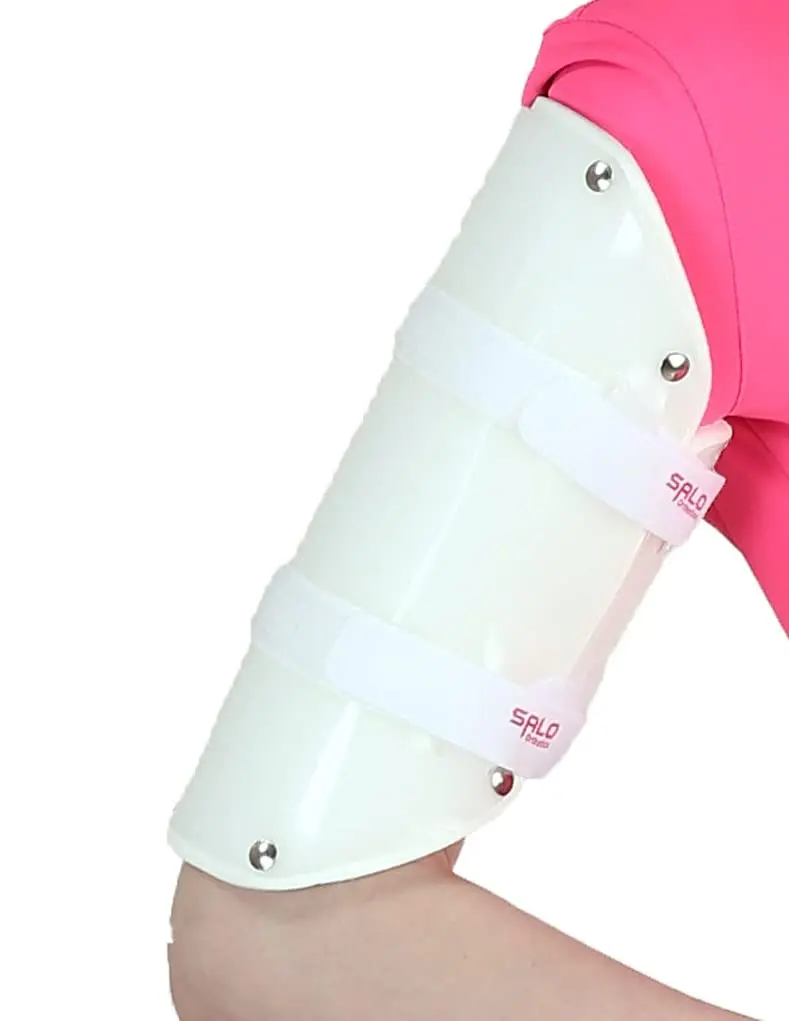
Humerus Brace
Features
- Hydrostatic Compression for Fracture Stabilisation Without Rigid Immobilisation
- Preserves Full Shoulder & Elbow Range of Motion During Fracture Healing
- Thermoplastic Panels for Custom-Moulded Anatomical Fit
- Clinically Proven Union Rates in Humeral Shaft Fracture Management
- Adjustable Velcro Strap Closure for Volume-Responsive Secure Fit
- Indicated for Both Primary Fracture Management & Non-Union Treatment
- Lightweight, Low-Profile Design for Daily Wearability & Patient Independence
Humerus Brace Functional Humeral Shaft Fracture Orthosis for Conservative Fracture Management, Hydrostatic Stabilisation & Upper Limb Function Preservation
The Humerus Brace is a clinically established functional orthosis designed for the conservative management of humeral shaft (diaphyseal) fractures one of the most common upper limb fractures encountered in both trauma and orthopaedic practice. Humeral shaft fractures are common orthopaedic injuries, representing 1% to 5% of all fractures a significant clinical burden that has historically been managed conservatively with functional bracing as the gold standard non-operative approach, with the humerus brace serving as the primary orthopaedic device through which this well-evidenced treatment strategy is delivered. By harnessing the hydrostatic compressive properties of the soft tissue envelope surrounding the humerus, the functional brace provides the fracture stabilisation required for reliable bony union while simultaneously preserving the full functional mobility of the shoulder and elbow joints a dual advantage that defines the functional bracing approach and distinguishes it fundamentally from conventional cast immobilisation.
The Biomechanical Foundation: Sarmiento's Functional Bracing Principle
The theoretical and clinical basis for the humerus brace is rooted in the pioneering work of Augusto Sarmiento, whose functional fracture bracing philosophy developed and validated through decades of clinical research from the 1960s onwards established that fracture healing does not require complete rigid immobilisation of the fracture site. Instead, Sarmiento demonstrated that the soft tissue envelope surrounding a long bone fracture, when contained within a closely fitted brace, generates sufficient hydrostatic compressive pressure on the fracture site to stabilise fragments adequately for healing particularly in the presence of the dynamic muscular activity that occurs during normal daily upper limb use.
In the humerus, the thick muscular envelope of the biceps, triceps, and brachialis provides an ideal medium for this hydrostatic stabilisation mechanism. When the humerus brace encircles this musculature with firm, circumferential thermoplastic panels, the compression generated within the contained soft tissue compartment acts directly on the fracture site reducing inter-fragmentary motion to the range that supports callus formation and endochondral ossification, while the gentle axial and bending loads introduced through normal upper limb activity provide the mechanical stimulation that promotes osteogenesis and fracture consolidation.
Clinical Evidence: Union Rates & Functional Outcomes
The clinical evidence base supporting functional brace management of humeral shaft fractures is substantial and clinically compelling. Non-operative management of humeral shaft fractures using a functional brace remains widely practiced, with modern outcome data confirming that this approach delivers reliable fracture union and excellent functional recovery in appropriately selected patients. In one prospective case series, all fractures achieved union at a mean of 10 weeks a consolidation timeline consistent with the biological healing capacity of the humeral shaft with the majority of patients achieving excellent or very good outcomes according to validated clinical criteria at final follow-up. Shoulder and elbow range of motion was well-maintained at final assessment, reflecting the fundamental functional advantage of the open-joint brace design over cast immobilisation approaches.
Historically, non-operative management consisting of functional bracing, splinting, or casting has been the gold standard treatment for humeral shaft fractures a position that reflects both the robust clinical evidence base for conservative management and the significant risks associated with surgical alternatives, including infection, nerve injury, hardware failure, and the prolonged rehabilitation required following operative fixation. For patients whose fracture characteristics fall within the accepted alignment parameters for conservative management less than 20 degrees of anterior/posterior angulation, less than 30 degrees of varus/valgus angulation, and less than 3 centimetres of shortening the humerus brace offers a clinically reliable, patient-friendly, and cost-effective pathway to fracture healing without surgical intervention.
The Clinical Management Protocol: From Slab to Functional Brace
The standard clinical protocol for functional brace management of humeral shaft fractures typically involves an initial period of two weeks in a U-shaped coaptation slab applied in the immediate post-injury period when pain, swelling, and soft tissue bruising preclude comfortable application of the close-fitting functional brace. Following this initial period, once the acute soft tissue reaction has subsided and fracture alignment has been confirmed radiographically, the patient transitions to the functional humerus brace worn continuously until radiological union is achieved, typically at eight to twelve weeks from injury. Clinical and radiological assessments are conducted weekly during the first month post-bracing and biweekly thereafter to monitor fracture alignment, union progress, and any developing complications.
The transition from slab to functional brace is a critical moment in the patient's recovery it marks the shift from passive immobilisation to active functional management, with the patient progressively reintroducing shoulder and elbow mobility and daily upper limb activities under the protection of the brace. The free-joint design of the humerus brace enables this functional reactivation from the moment of brace application, avoiding the progressive joint stiffness, muscle wasting, and proprioceptive deficit that prolonged immobilisation in a long cast would otherwise produce.
Indications, Selection Criteria & Contraindications
The humerus brace is indicated for closed diaphyseal humerus fractures meeting the accepted alignment criteria for conservative management, including mid-shaft transverse, oblique, and spiral fracture patterns in skeletally mature patients. It is also indicated for humeral shaft non-union where the mechanical environment provided by the functional brace, combined with the dynamic muscular loading of daily activities, can promote the biological healing response in fractures that have failed to unite following an initial period of immobilisation. General consensus on absolute indications for operative fixation which would preclude the use of a functional brace include open fractures, concomitant brachial artery or plexus injury, and ipsilateral forearm fracture constituting a floating elbow, as well as polytrauma presentations where early upper limb weight-bearing for crutch or frame mobilisation is required.
Fabrication, Fitting & Patient Education
Successful outcomes with the humerus brace are critically dependent on the quality of the initial fitting and the adequacy of patient education regarding brace use, strap adjustment, and compliance expectations. The thermoplastic panels are heat-moulded over the upper arm to achieve the close, anatomically accurate fit that maximises hydrostatic compression with particular attention to the medial and lateral aspects of the arm where the biceps and triceps muscle bellies provide the primary compressive medium. Patients are instructed in strap adjustment technique to maintain appropriate compression as arm swelling reduces, the importance of pendulum shoulder exercises to prevent glenohumeral stiffness, and the positioning strategies including sleeping upright in the early weeks that reduce the gravitational distraction forces at the fracture site during the initial healing period.
Indicated For:
Closed humeral shaft (diaphyseal) fractures including transverse, oblique, spiral, and comminuted patterns within accepted alignment criteria humeral shaft non-union, post-operative humeral shaft management following failed conservative treatment, pathological humeral fractures in selected presentations, and any closed humeral diaphyseal fracture meeting the clinical and radiographic criteria for non-operative functional brace management in skeletally mature patients.
Add your review
Your email address will not be published. Required fields are marked *
Please login to write review!
Looks like there are no reviews yet.

M. A. Medical Supports