
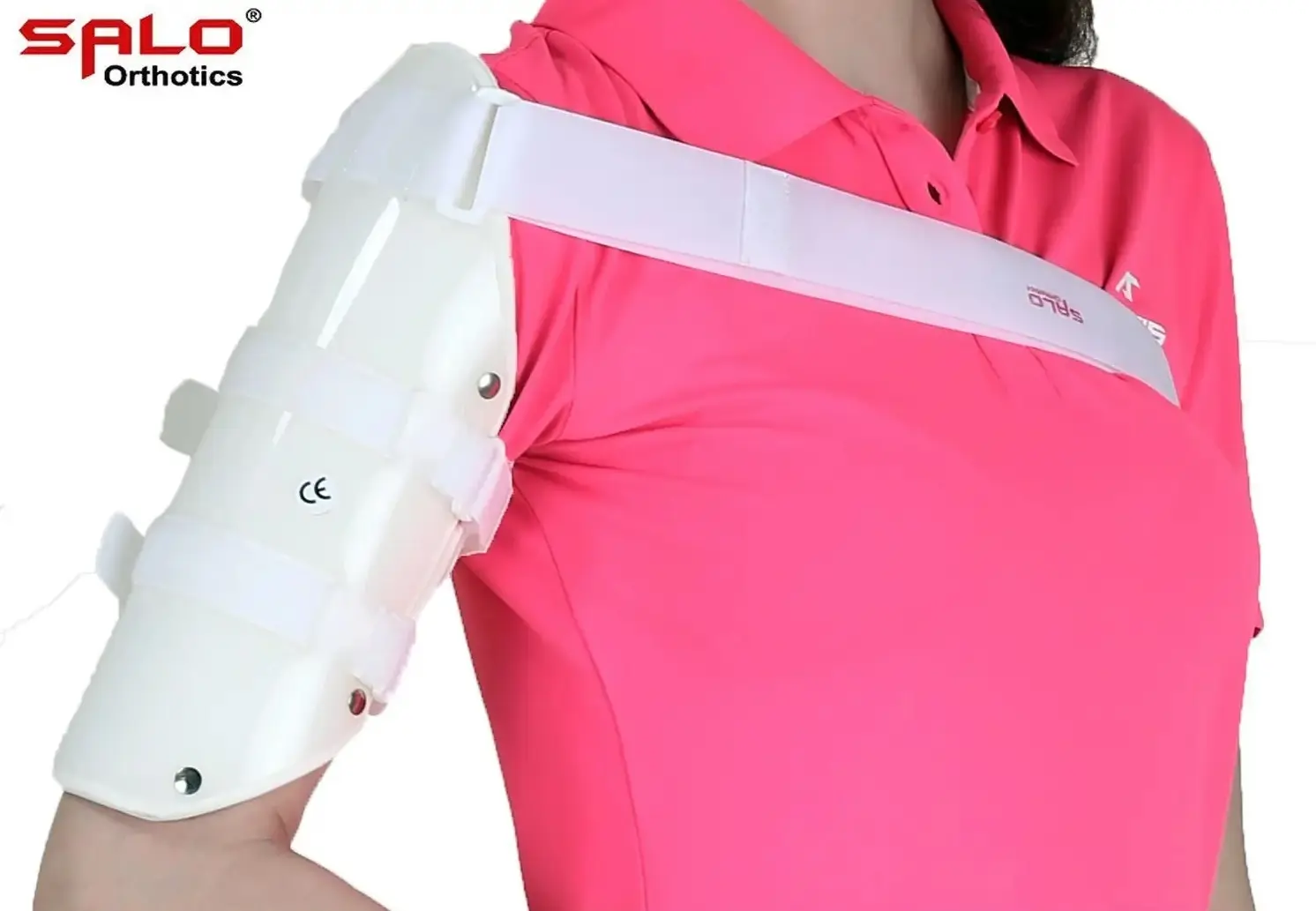
Humerus Brace Hi Up
Features
- Extended Proximal Coverage with Integrated Deltoid Cap for Shoulder Stabilisation
- Over-the-Shoulder Suspension Strap for Anti-Migration Security
- Total Contact Circumferential Soft Tissue Compression for Hydrostatic Fracture Stabilisation
- Indicated for Proximal, Mid-Shaft & High Distal Third Humeral Fractures
- Trimmable Thermoplastic Panels for Individually Customised Anatomical Fit
- Preserves Elbow Range of Motion for Upper Limb Function During Healing
- Lightweight, Reversible & Suitable for Left or Right Arm Application
Humerus Brace Hi-Up Over-the-Shoulder Humeral Fracture Orthosis for Proximal & High-Shaft Humerus Fracture Management, Deltoid Stabilisation & Protected Functional Recovery
The Humerus Brace Hi-Up is an advanced configuration of the functional humeral fracture orthosis, engineered specifically to address the clinical limitations of the standard mid-shaft humerus brace in proximal and high humeral shaft fracture presentations. While the standard humerus brace delivers reliable hydrostatic circumferential compression to the humeral shaft, its coverage terminates at the proximal arm leaving the deltoid region, proximal humeral fragment, and shoulder-level fracture zone without the structural support and anti-migration anchoring that higher fractures critically require. The Hi-Up configuration resolves this clinical gap through the addition of an integrated deltoid cap and an over-the-shoulder suspension strap extending the orthosis's functional reach from the mid-shaft upward through the proximal humerus and into the shoulder region, and securing the entire assembly against gravitational distal migration through trunk-anchored contralateral suspension.
The Clinical Challenge of Proximal & High-Shaft Humeral Fractures
Proximal humerus fractures are prevalent in older adults, particularly women, primarily due to osteoporosis and increased fall risk making them one of the most common fracture presentations encountered in both emergency and elective orthopaedic practice. The proximal humerus presents unique anatomical and biomechanical challenges for conservative orthotic management that are not present in mid-shaft fractures. The proximity of the fracture to the shoulder joint means that the standard brace's proximal termination at the upper arm is insufficient the proximal fragment is influenced by the powerful rotator cuff musculature, the deltoid, and the weight of the arm itself, all of which generate deforming forces at the fracture site that a mid-shaft brace panel system cannot adequately counteract. The Hi-Up brace's deltoid cap directly addresses this anatomical reality by extending the compressive and positional control of the orthosis to the level at which these deforming forces originate.
The Deltoid Cap: Engineering Proximal Control into the Functional Brace
The deltoid cap is the structural feature that distinguishes the Hi-Up from the standard humerus brace and determines its clinical suitability for proximal and high-shaft fracture presentations. Extending the thermoplastic shell from the upper arm upward to encircle the deltoid muscle bulk and the greater tuberosity region, the deltoid cap serves three critical clinical functions simultaneously. First, it extends the circumferential compression envelope of the brace to the proximal humerus maximising the hydrostatic soft tissue pressure that stabilises the proximal fracture fragment against the deforming influence of the rotator cuff and deltoid musculature. Second, it provides a proximal structural anchor for the brace itself preventing the downward gravitational migration along the arm that is the most common practical failure mode of standard humerus braces in active patients, and that, if unchecked, allows the brace to drift below the fracture site and render the hydrostatic compression therapeutically ineffective. Third, it delivers a degree of shoulder joint positional control limiting the extremes of glenohumeral abduction and rotation that would stress the proximal fracture site during the early healing phase when the fracture is at its greatest mechanical vulnerability.
The Over-the-Shoulder Strap: Solving the Anti-Migration Challenge
The over-the-shoulder suspension strap is the complementary feature that transforms the deltoid cap from a structural component into a reliably anti-migratory system. By routing a suspension strap from the Hi-Up brace, over the opposite shoulder, and anchoring it at the contralateral axilla or trunk, the brace leverages the stable skeletal structure of the contralateral shoulder girdle as a fixed point from which to suspend the entire orthotic assembly on the injured arm. This cross-body suspension eliminates the gravitational descent of the brace that the weight of the arm would otherwise cause a particularly important consideration in larger, heavier upper arms where the gravitational load is greatest, and in elderly or osteoporotic patients where the proximal fragment is most vulnerable to deformity from unresisted forces. The strap also functions to limit shoulder abduction and rotation reducing the risk of the patient inadvertently loading the fracture site through excessive glenohumeral movement during the acute healing phase.
Comparison with the Standard Humerus Brace: When to Prescribe the Hi-Up
The prescribing decision between the standard humerus brace and the Hi-Up configuration is fundamentally driven by the level of the fracture within the humeral shaft and the degree of proximal control required. For isolated mid-shaft and distal third humeral shaft fractures in the accepted alignment parameters for conservative management, the standard brace provides reliable hydrostatic compression and fracture stabilisation with both shoulder and elbow joints free the Sarmiento brace allows some movement, which helps one to make a full recovery. However, for fractures in the proximal third of the humeral shaft, fractures at the surgical neck level, high shaft fractures with a short proximal fragment, and presentations where the standard brace is observed to migrate distally despite patient compliance, the Hi-Up configuration provides the proximal extension of coverage and the anti-migration anchoring that the clinical situation demands. The Hi-Up is also the appropriate prescription in patients with osteoporosis, reduced deltoid and rotator cuff strength, or high functional demands during the healing period where the additional proximal control and brace security that the deltoid cap and shoulder strap provide are most clinically meaningful.
Management Protocol: Integration into the Conservative Fracture Pathway
The Humerus Brace Hi-Up is applied following the same initial management period as the standard humerus brace typically after two weeks in a coaptation slab or arm sling, once acute post-injury swelling has sufficiently subsided to allow the close, circumferential fit of the thermoplastic panels to be achieved without pain or vascular compromise. Clinical and radiological review follows the standard functional fracture bracing protocol weekly assessment during the first month, biweekly thereafter until radiological union is confirmed. The over-the-shoulder strap is adjusted at each review to ensure continued anti-migration support as arm volume changes, and the thermoplastic panels are modified if changes in limb contour or fracture alignment require adjustment of the compressive interface.
Patient education regarding the wearing schedule, strap adjustment technique, pendulum shoulder exercises for glenohumeral mobility maintenance, and the sleeping position strategies that reduce fracture site distraction during the overnight hours is a critical component of successful Hi-Up brace management and the clinician responsible for fitting the device should dedicate sufficient consultation time to this educational component at every clinical contact.
Hygiene, Maintenance & Practical Wearability
Plastic shells can be wiped with a damp cloth and disinfectant or mild soap a simple, rapid decontamination process that meets clinical hygiene requirements and supports the daily cleaning routine that patients and carers can easily maintain at home. The reversible left-right design means that a single Hi-Up brace can be configured for either arm without structural modification reducing stock requirements for clinical departments and orthotics practices while maintaining the full clinical functionality of the device for all patients regardless of which arm is injured.
Indicated For:
Proximal third humeral shaft fractures, surgical neck humeral fractures amenable to conservative management, high mid-shaft humeral fractures with a short proximal fragment, any humeral shaft fracture where standard brace migration is observed during the management course, osteoporotic proximal humeral fractures in elderly patients selected for non-operative treatment, post-operative humeral fracture management following failed conservative treatment, and any closed humeral fracture presentation where deltoid-level proximal control and cross-body anti-migration suspension are required to achieve the structural stability necessary for reliable fracture consolidation.
Add your review
Your email address will not be published. Required fields are marked *
Please login to write review!
Looks like there are no reviews yet.

M. A. Medical Supports