
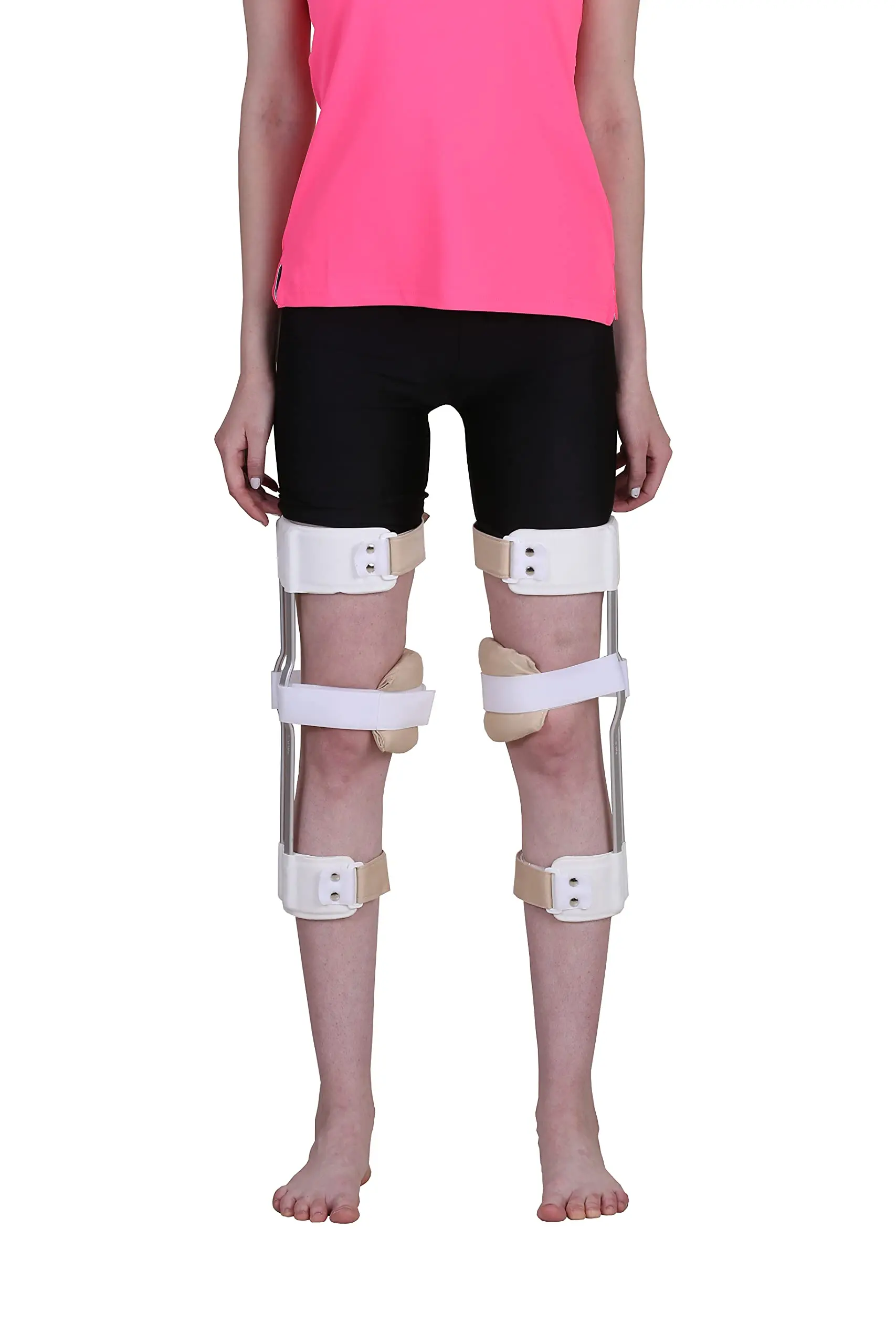
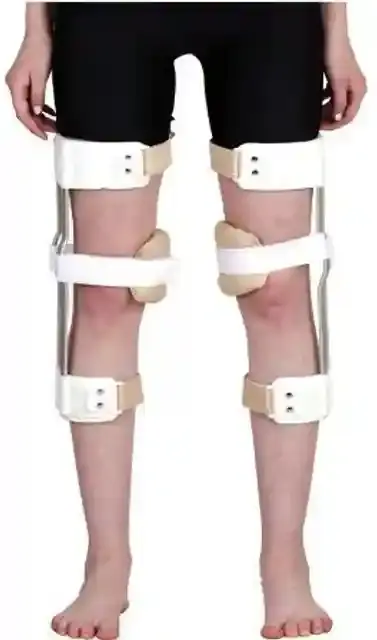
Knee Valgum Brace- 1 piece
Features
- Targeted Three-Point Pressure System for Genu Valgum Correction
- Built-In Aluminium Stays for Structural Rigidity & Mediolateral Control
- Single-Piece (1 Piece) Configuration for Unilateral Deformity Management
- Applicable for Both Genu Valgum & Genu Varum Deformities
- Adjustable Straps for Progressive Corrective Tension & Growth Accommodation
- Padded Inner Lining for Skin Protection During Prolonged Corrective Wear
- Breathable, Lightweight & Suitable for Both Paediatric & Adult Use
Knee Valgum Brace (1 Piece) Corrective Knock Knee Orthosis for Genu Valgum, Blount's Disease & Frontal Plane Knee Malalignment
The Knee Valgum Brace (1 Piece) is a purpose-designed orthopaedic corrective orthosis developed to address one of the most common frontal plane lower limb malalignment conditions encountered in both paediatric and adult orthopaedic practice genu valgum, commonly known as knock knee. Characterised by the medial displacement of the knee joint relative to the body's mechanical axis, genu valgum causes the knees to angle inward and the lower legs to deviate outward, resulting in an intermalleolar gap when the knees are brought together. Supplied as a single-piece device for targeted unilateral application, this brace delivers a clinically structured corrective force system that provides both the mechanical correction needed to reduce the deformity and the joint stability required for safe, comfortable daily activity throughout the management programme.
Understanding Genu Valgum: Causes, Consequences & the Role of Bracing
Genu valgum is a coronal plane deformity of the lower extremity that may be physiological and self-resolving in young children — typically between the ages of two and six, where a modest degree of valgus alignment is a normal part of skeletal development — or pathological, arising from conditions such as rickets, renal osteodystrophy, post-traumatic growth plate injury, Blount's disease, metabolic bone disease, ligament laxity, or obesity-related mechanical overloading. While physiological valgus alignment is a normal part of skeletal development and typically resolves by the age of seven to eight years, persistent or pathological valgus deformities beyond this age can lead to significant mechanical axis deviation — with consequences that include excessive lateral compartment loading at the knee, accelerated articular cartilage wear, patellar maltracking, anterior knee pain, circumduction gait, difficulty with running and sports participation, and the progressive development of lateral compartment knee osteoarthritis if the malalignment is left uncorrected into adulthood. nih
An orthosis like a brace or a splint has been suggested for children under eight years old to help guide bone growth — with the biological rationale rooted in the high skeletal plasticity of the growing child's bone, where sustained, correctly directed corrective forces applied through an orthosis during weight-bearing can influence the growth pattern of the distal femoral and proximal tibial physes, gradually reducing the valgus angle as new bone is deposited in a more aligned direction. Doctors may recommend braces or splints for some children in addition to or instead of orthotics, with the braces designed to help the bones grow in the correct position — positioning orthotic management as a first-line, non-invasive intervention that is both clinically appropriate and practically accessible for families seeking to address their child's knock knee deformity without surgical intervention.
The Three-Point Pressure Correction Principle
The biomechanical mechanism through which the Knee Valgum Brace delivers its corrective effect is the three-point pressure system a foundational principle of deformity correction orthoses that applies opposing forces at three anatomical locations to generate a corrective moment at the deformity apex. In genu valgum correction, the primary corrective force is applied laterally at the medial aspect of the knee joint the apex of the angular deformity while opposing counter-forces are simultaneously applied at the medial thigh above and the medial calf below. Together, these three forces create a varus corrective moment at the knee that directly opposes and gradually reduces the pathological valgus angulation of the tibiofemoral joint.
The rigid aluminium stays positioned within the lateral aspects of the brace are essential to the mechanical effectiveness of this force system. In order to correct leg malalignment, an orthosis extends along the outer side of the leg with an upper leg part and a lower leg part interconnected by a rotary joint at the level of the knee joint, with the upper and lower leg parts angled with respect to one another at an angle deviating from 180° such that a torque for correcting the leg malalignment is exerted on the knee joint the structural principle that the aluminium-stayed valgum brace applies in a practical, adjustable, and patient-accessible format that can be used in both clinical and home settings without requiring specialist application skills.
Blount's Disease & Tibial Vara: A Specific Paediatric Indication
Beyond idiopathic genu valgum, the Knee Valgum Brace has specific clinical application in the management of Blount's disease (tibia vara) a pathological condition characterised by abnormal growth of the medial aspect of the proximal tibial physis, resulting in progressive tibial bowing and medial joint line depression that is distinct from simple knock knee in its aetiology, radiographic appearance, and management requirements. In early-onset Blount's disease typically presenting before the age of four orthotic management with a corrective brace is the recommended first-line treatment, with the brace applying the laterally directed corrective force at the proximal tibia required to unload the diseased medial physis and allow more symmetric tibial growth. The Knee Valgum Brace's adjustable three-point force system and accommodating strap design make it clinically suitable for this demanding paediatric application, where consistent daily wear across a prolonged treatment period is required to achieve the physis-level correction that determines long-term outcomes.
Single-Piece Supply: Clinical Rationale for Unilateral Application
The 1-piece supply configuration reflects a clinically important distinction in genu valgum presentation. A proportion of patients particularly those with post-traumatic, post-infective, or growth plate injury aetiology present with asymmetric or purely unilateral valgum deformity, where one limb requires active orthotic correction while the other is within normal alignment parameters. In these presentations, applying bilateral bracing would impose unnecessary mechanical loading on the unaffected limb and reduce patient compliance with the overall wearing schedule. The single-piece Knee Valgum Brace allows the treating clinician to concentrate corrective intervention precisely where it is clinically required providing an accurate, efficient, and practically manageable solution for unilateral presentations that bilateral pairs cannot optimally address.
Wearing Schedule, Progressive Correction & Patient Compliance
The effectiveness of the Knee Valgum Brace is directly proportional to the consistency and duration of its application both the daily wearing duration and the total period of brace use across the treatment programme determine the degree of corrective response achieved. An initial adaptation period with gradually increasing wear duration allows the patient and their soft tissues to adjust to the corrective forces, after which a full therapeutic wearing schedule typically incorporating both daytime weight-bearing use and, where tolerated, overnight positional correction maximises the cumulative corrective effect. Regular clinical review at prescribed intervals allows the treating orthotist or orthopaedic surgeon to assess the response to treatment, progress the corrective force as the deformity reduces, adjust the brace configuration to reflect changes in limb size and shape, and determine the appropriate end point of orthotic management based on clinical and radiographic assessment of the tibiofemoral angle.
Indicated For:
Paediatric and adolescent genu valgum (knock knee) beyond physiological resolution age, pathological genu valgum secondary to rickets, metabolic bone disease, obesity-related mechanical overload or post-traumatic growth plate injury, Blount's disease (tibia vara) in early-onset presentations, unilateral genu valgum requiring single-limb corrective intervention, symptomatic adult genu valgum with lateral compartment overloading, and conservative non-surgical frontal plane knee malalignment management in patients seeking to delay or avoid surgical realignment procedures.
Add your review
Your email address will not be published. Required fields are marked *
Please login to write review!
Looks like there are no reviews yet.

M. A. Medical Supports