
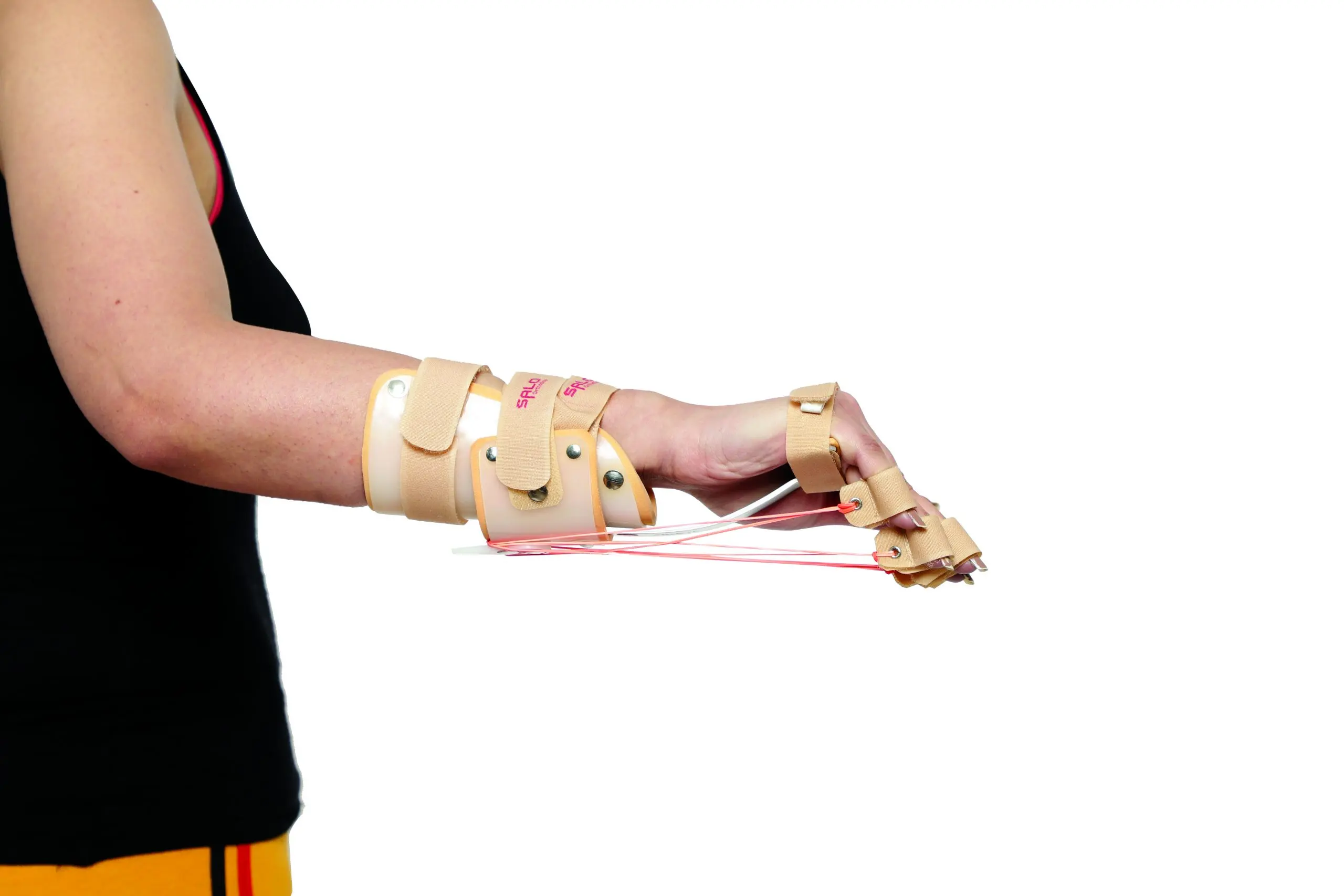
Knuckle Bender
Features
- Dynamic Rubber Band Traction for Progressive MCP Flexion
- Palmar & Phalangeal Components with Dorsal Counterforce Bar
- Clinically Indicated for Ulnar & Median Nerve Palsy Anti-Claw Management
- Adjustable Traction Force Through Rubber Band Selection
- Applicable for MCP Extension Contracture from Multiple Aetiologies
- Post-Surgical MCP Arthroplasty Rehabilitation
- Hygienic, Skin-Safe & Fully Washable Rubber Band & Thermoplastic Construction
Knuckle Bender Splint Dynamic MCP Flexion Orthosis for Claw Hand Correction, Ulnar & Median Nerve Palsy Management & Post-Surgical MCP Rehabilitation
The Knuckle Bender Splint is a clinically established dynamic hand orthosis designed to deliver a low-load, continuous, rubber band–assisted flexion force to the metacarpophalangeal (MCP) joints of all fingers simultaneously progressively restoring MCP flexion range of motion, correcting the pathological MCP hyperextension of claw hand deformity, and providing the dynamic anti-claw positioning required in ulnar and median nerve palsy management. One of the most widely used and clinically validated dynamic hand splints in occupational therapy and hand therapy practice, the knuckle bender splint occupies a unique position in the hand orthosis armamentarium combining the biomechanical elegance of a three-component, three-point pressure design with the practical simplicity of rubber band traction to deliver a versatile, adjustable, and clinically effective flexion force across the entire MCP joint row within a single lightweight device.
Understanding the Clinical Problem: MCP Extension Contracture & Claw Hand
The metacarpophalangeal joint is the primary determinant of hand posture and functional grip configuration. When the MCP joints become fixed or progressively restricted in extension whether through post-traumatic dorsal capsular contracture, intrinsic muscle imbalance following peripheral nerve injury, prolonged immobilisation in the intrinsic-minus position, burn scar dorsal contracture, rheumatoid joint destruction, or post-surgical adhesion formation the functional consequences for the hand are profound. Loss of MCP flexion significantly reduces grip span and grip force, impairs the ability to close the hand around objects of any size, and produces the characteristic claw posture that is both functionally limiting and cosmetically distressing for patients across all age groups and activities of daily living.
In peripheral nerve injury presentations, the claw deformity arises through a specific biomechanical mechanism: loss of intrinsic muscle function following ulnar or median nerve injury eliminates the primary MCP flexion force that balances the extensor digitorum's tendency to hyperextend the proximal phalanx, while the now-unopposed extrinsic flexors pull the interphalangeal joints into flexion producing the characteristic claw posture of MCP hyperextension combined with IP flexion that is pathognomonic of intrinsic minus hand. In median or ulnar nerve injuries, the MCP joint has a tendency to become hyperextended due to lack of muscle strength in the hand intrinsics and the dynamic knuckle bender splint directly corrects this imbalance by substituting for the absent intrinsic flexion force at the MCP joint, restoring the intrinsic-plus position that enables normal finger extension mechanics, effective grip, and proper functioning of the extensor mechanism across all phalangeal joints.
The Biomechanical Design: Three-Point Force System for Pure MCP Flexion
The knuckle bender splint achieves its targeted MCP flexion effect through a precisely engineered three-component mechanical system. The palmar component a volar plate or circumferential palmar base provides the proximal structural anchor from which the rubber band traction system operates, distributing the reaction forces of the traction system broadly across the palm and proximal phalanges without concentrating load at any single anatomical contact point. The phalangeal component a dorsal finger bar or phalangeal cuff positioned across the proximal phalanges of all fingers is the distal point of attachment for the rubber band traction, transmitting the elastic traction force as a palmar-directed force at the proximal phalanx level that generates the MCP flexion moment. The volar counterforce barpositioned at the MCP joint level provides the third point of the three-point pressure system directing an anteroposterior counterforce at the MCP joint that ensures the flexion traction is expressed as pure joint rotation rather than longitudinal phalanx translation.
The rubber bands connecting the palmar and phalangeal components are the active therapeutic elements of the system their elastic properties generating the continuous, sustained flexion force that maintains the MCP joints at their end range of flexion throughout the wearing period, exploiting the viscoelastic creep and stress relaxation properties of the contracted capsular and dorsal extensor mechanism tissues to progressively elongate and restore functional extensibility. The traction force is directly determined by the elastic stiffness and pre-tension of the rubber bands selected providing the treating therapist with a straightforward, clinically accessible mechanism for adjusting the therapeutic force in response to patient tolerance and treatment progress without requiring specialised tools or splint modification.
Claw Hand Correction: The Primary Neurological Indication
The knuckle bender splint's most clinically significant and neurologically specific application is in the management of claw hand deformity following ulnar and median nerve injuries. In ulnar nerve palsy at the wrist level, the complete loss of interosseous and hypothenar intrinsic muscle function produces claw deformity affecting predominantly the ring and little fingers the digits whose MCP joints are most dependent on ulnar-innervated intrinsic muscle function for flexion control. In combined median and ulnar nerve palsy, all four fingers are affected. The dynamic knuckle bender splint by applying a continuous elastic MCP flexion force that substitutes for the absent intrinsic muscle activation restores the balance of forces at the MCP joint, corrects the hyperextension posture, and simultaneously facilitates active IP extension by restoring the mechanical advantage of the extrinsic extensors through the corrected MCP alignment. This dual benefit passive MCP flexion correction and enhanced active IP extension makes the dynamic knuckle bender splint the most biomechanically appropriate orthotic intervention for claw hand management, addressing both the primary deformity and its functional consequences within a single device.
Post-Traumatic & Post-Surgical MCP Extension Contracture
Beyond neurological applications, the knuckle bender splint is widely prescribed for MCP extension contractures arising from orthopaedic and post-surgical causes. Following dorsal hand trauma including metacarpal fractures, dorsal hand burns, crush injuries, and complex lacerations the inflammatory response generates substantial dorsal oedema that settles in the path of least resistance: the dorsal hand, where the loose areolar tissue of the dorsal subcutaneous space accommodates large volumes of inflammatory exudate. This dorsal oedema positions the MCP joints in extension and the IP joints in flexion the intrinsic minus position that, if allowed to persist without corrective orthotic intervention, rapidly consolidates into a fixed contracture pattern as the oedema organises into fibrotic scar tissue. The knuckle bender splint provides the dynamic MCP flexion force that directly opposes this oedema-driven contracture development during the acute and subacute phases of hand injury management.
Following MCP arthroplasty in rheumatoid arthritis where the replacement of destroyed MCP joints with flexible silicone implants offers significant potential functional improvement the post-operative rehabilitation programme critically depends on achieving and maintaining adequate MCP flexion while simultaneously controlling ulnar drift of the reconstructed finger column. The dynamic knuckle bender splint, by applying a directed flexion force to the MCP joints during the healing phase, supports the development of MCP flexion range at the new joint while the surrounding soft tissue structures are guided into the balanced, aligned configuration that determines the long-term functional and cosmetic outcome of the arthroplasty.
Customisation, Fabrication & Clinical Prescription
The knuckle bender splint can be fabricated as a custom thermoplastic device by the treating occupational therapist moulding the palmar component and phalangeal bar to the individual patient's hand anatomy for a precise, anatomically accurate fit or as a prefabricated stainless steel and felt construction in standard sizing. The rubber band selection is determined at the initial fitting session based on the degree of MCP extension contracture, the severity of the deforming forces, and the patient's pain tolerance, with progressive upgrading of rubber band strength as range of motion improves and the tissues become more responsive to increasing therapeutic load. Regular clinical review at two to four week intervals assesses MCP flexion range gains, skin integrity at all splint contact points, rubber band wear and elasticity maintenance, and the need to advance the prescription in response to treatment progress.
Contraindications & Clinical Precautions
The knuckle bender splint is contraindicated in the presence of fixed bony MCP joint contractures that are unlikely to respond to conservative stretching, acutely inflamed or infected MCP joints where increased joint loading would aggravate the inflammatory process, unstabilised MCP fractures or post-operative repairs in the early healing phase where dynamic loading of the joint is contraindicated by the surgical team, and skin integrity compromise at the dorsal hand or finger contact zones that would be further damaged by the rubber band or phalangeal component pressure. In patients with sensory impairment including those with peripheral nerve injuries who lack normal protective sensation over the dorsal hand and fingers particular vigilance is required during wearing to identify pressure-related skin damage that the patient cannot detect through normal pain pathways.
Indicated For:
Claw hand deformity (ulnar nerve palsy, median nerve palsy, combined median-ulnar nerve palsy), intrinsic minus hand positioning and correction, MCP joint extension contracture from post-traumatic dorsal oedema, burn scar dorsal hand contracture, prolonged immobilisation-related MCP stiffness, flexor tendon injury with PIP flexion restriction, post-MCP arthroplasty rehabilitation in rheumatoid arthritis, trigger finger conservative management (MCP blocking), and any clinical presentation requiring dynamic low-load flexion traction at the metacarpophalangeal joints of the fingers to restore functional MCP flexion range of motion.
Add your review
Your email address will not be published. Required fields are marked *
Please login to write review!
Looks like there are no reviews yet.

M. A. Medical Supports