
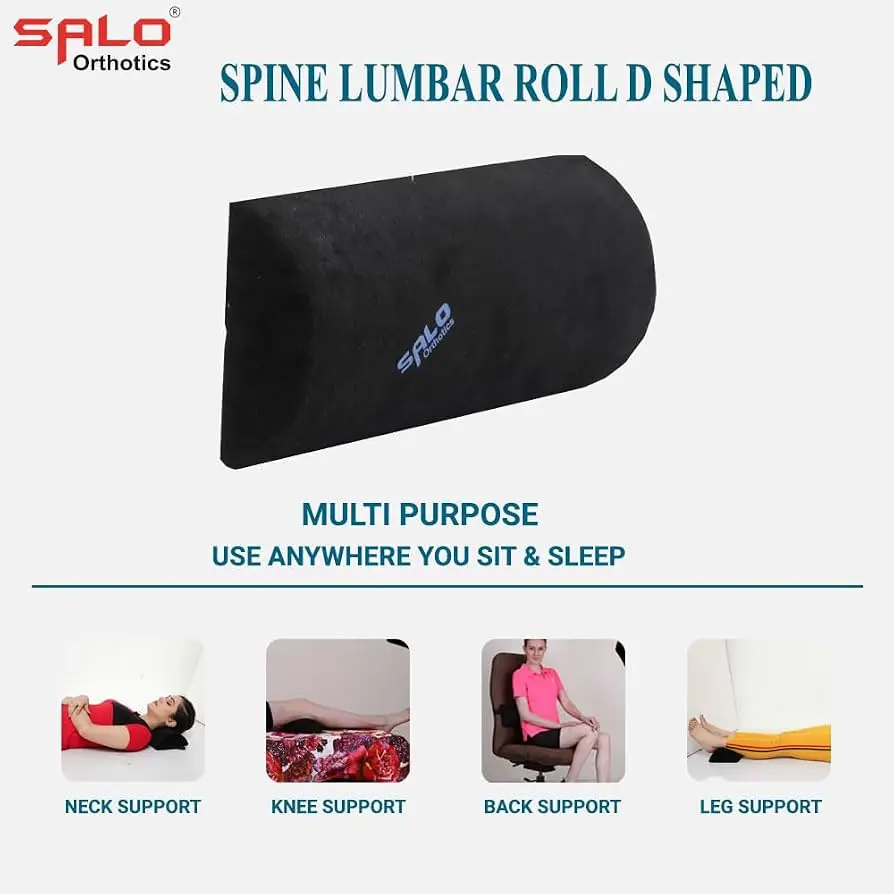
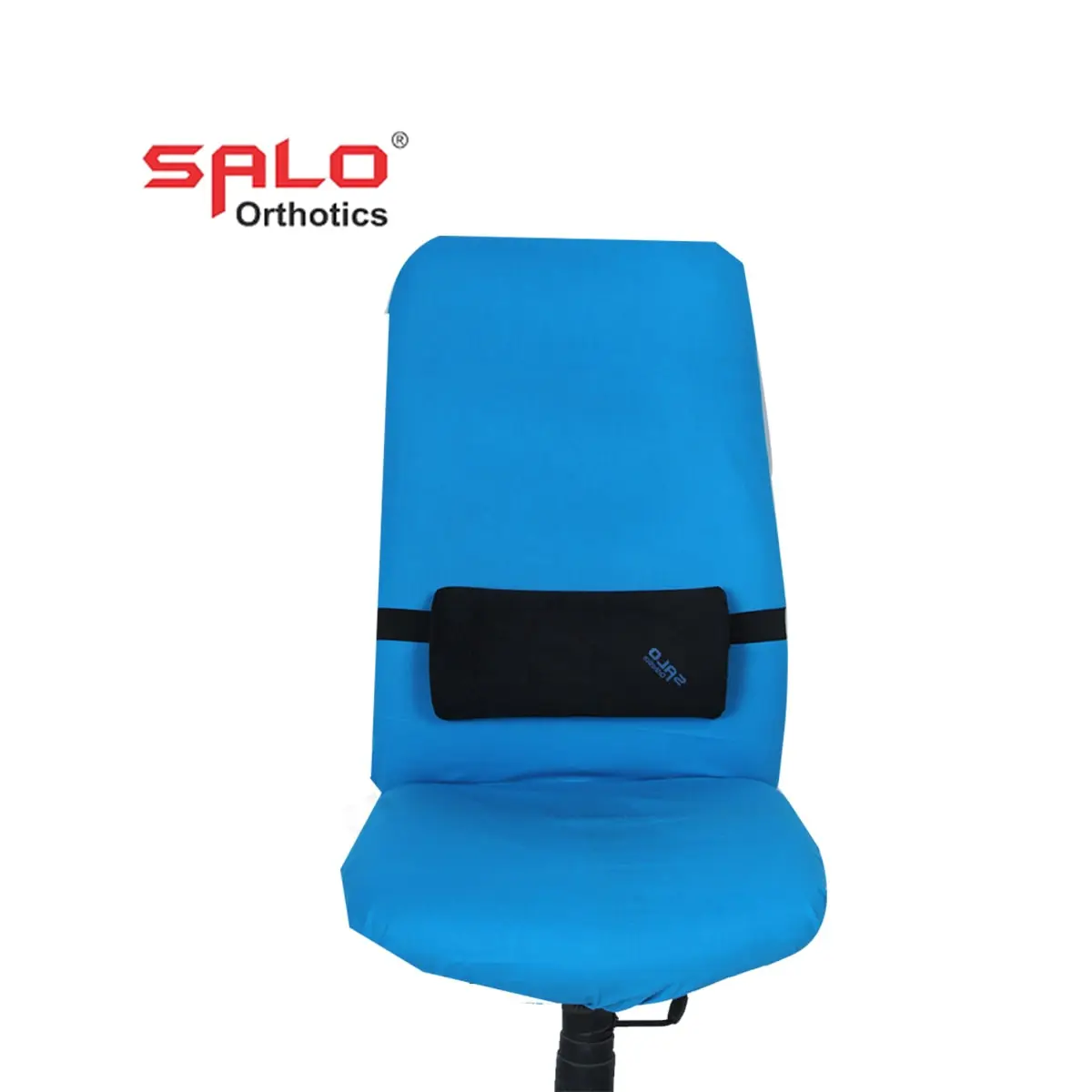
Lumbar Roll (D-Shaped)
Features
- Unique D-Shaped Semi-Circular Profile That Rests Flat & Stable Against Any Chair Back
- Clinically Designed to Maintain the Natural Lumbar Lordosis & Prevent Slouching
- Physiotherapist & Chiropractor Recommended for Lower Back Pain Prevention & Management
- Compact, Slim 2-Inch Profile for Low-Profile Comfort Without Excessive Lumbar Arch
- Adjustable Elastic Buckle Strap for Secure, Height-Specific Positioning on Any Seat
- High-Density Foam or Memory Foam Construction for Durable, Shape-Retaining Support
- Lightweight, Portable & Universally Compatible for Office, Home, Car & Travel
Lumbar Roll (D-Shaped) Compact Physiotherapist-Recommended Lower Back Support for Lumbar Lordosis Restoration, Posture Correction & Seated Back Pain Relief
The Lumbar Roll (D-Shaped) is a clinically established, physiotherapist-recommended lower back support device that delivers targeted lumbar lordosis restoration through a precisely designed semi-circular foam profile combining the biomechanical effectiveness of a dedicated lumbar support with the practical simplicity, portability, and universal chair compatibility that make it the most widely prescribed and clinically utilised lumbar roll format in physiotherapy, chiropractic, and occupational health practice worldwide. D-shaped lumbar rolls are an excellent lumbar support designed to ensure you maintain an optimal spinal position for your lower back whilst sitting a lumbar roll is a must-have item for patients who suffer from lower back pain, especially considering the long duration we often sit, sometimes in excess of 8 hours per day — a clinical endorsement that reflects decades of physiotherapy practice experience with this product across the full spectrum of lower back conditions encountered in both acute and chronic pain management.
The D-Shape Advantage: Why Geometry Determines Clinical Effectiveness
The distinction between a D-shaped and a round (cylindrical) lumbar roll is not merely aesthetic it is a clinically significant design difference that determines the stability, positioning accuracy, and practical usability of the roll during seated use. A cylindrical round roll, with its uniformly curved circumference, contacts the chair back along a narrow convex line rather than a flat surface creating an inherently unstable interface that allows the roll to rotate forward, roll sideways, or slip downward along the chair back in response to the user's movements and positional adjustments during the seated working day. This instability requires frequent manual repositioning, reduces user confidence in the roll's protective function, and ultimately leads to compliance failure as users tire of constant adjustment.
The D-shaped profile resolves all of these limitations simultaneously. The original McKenzie D-Section Lumbar Roll is designed to provide firm and reliable lumbar support while sitting in almost any chair its unique D-shaped design rests flat against chair backs, making it ideal for those who prefer a higher level of support or have a larger lumbar lordosis the flat posterior surface of the D-roll creates a stable, broad contact zone against the chair back that prevents rotation and rolling, while the semi-circular convex anterior surface projects forward to fill the lumbar lordotic concavity with consistent, accurately directed anteroposterior support force. This combination of posterior chair back stability and anterior lumbar support delivery makes the D-shaped roll definitively superior to the cylindrical format for clinical lumbar support application a superiority that explains its universal recommendation by physiotherapists and the clinical adoption of the D-shape as the standard lumbar roll format for lower back pain management.
The Biomechanical Evidence: What Happens to the Lumbar Spine Without Support
The clinical rationale for the D-shaped lumbar roll is grounded in well-established spinal biomechanics research that documents the postural and mechanical consequences of unsupported seated posture. X-rays of the lower back during sitting demonstrate that the lower back falls into a flexed forward bent position this is particularly the case when sitting slouched the posterior pelvic tilt and lumbar flexion of unsupported sitting increases intradiscal pressure at the L4–L5 and L5–S1 levels by up to 40% compared to standing, progressively stretches the posterior longitudinal ligament and annular fibres of the intervertebral discs, and generates sustained eccentric loading on the lumbar facet joints and interspinous ligaments that accumulates into the progressive inflammatory pain and soft tissue fatigue that characterise chronic occupational lower back pain.
The D-shaped lumbar roll directly counteracts this biomechanical chain by applying a consistently directed anteriorly convex support force against the posterior lumbar structures pushing the lumbar spine gently forward to restore and maintain the natural inward lordotic curve throughout the seated working period. This lordosis restoration simultaneously tilts the pelvis anteriorly into its neutral position, redistributes intradiscal load away from the posterior annular fibres toward the central nucleus pulposus and anterior annular fibres, and reduces the posterior element loading that generates facet joint and interspinous ligament pain during prolonged flexion-loaded sitting. Sitting for extended periods of time can be detrimental to spinal health, distorting spinal curves, compressing discs, and creating pressure on the spine, leading to pinched nerves, numbness, tingling, and back pain a D-shaped lumbar cushion helps protect and maintain proper posture the clinical evidence confirming that lumbar support reduces these adverse biomechanical consequences of prolonged sitting is well-established across physiotherapy and ergonomics research literature.
McKenzie Method Alignment: The D-Shaped Roll in Evidenced Lumbar Rehabilitation
The D-shaped lumbar roll holds a specific and clinically important position within the McKenzie Method of Mechanical Diagnosis and Therapy the internationally established physiotherapy approach to spinal pain management that emphasises self-management through postural correction and repeated movement as primary therapeutic strategies. Robin McKenzie, the New Zealand physiotherapist who developed this method, identified maintained lumbar lordosis during sitting as a fundamental component of both the prevention and self-treatment of common lower back pain, and designed the D-section lumbar roll specifically to operationalise this clinical principle in a practical, universally applicable format. A D-shaped lumbar support designed by Robin McKenzie, this roll rests flat against chair backs for the self-treatment of back pain through postural correction during prolonged sitting the endorsement of the D-shaped lumbar roll within the McKenzie Method's evidence-based self-management framework provides the product with one of the strongest clinical evidence bases available for any lumbar support device.
Sizing Guidance: Selecting the Correct D-Roll Depth
The D-shaped lumbar roll is available in different depth variants that correspond to different anatomical needs and clinical presentations. D-shaped standard 4-inch is a good choice if your back is sensitive to pressure, you are petite, or you do not have a deep lower back curve D-shaped large 5-inch is great if you have a heavier build the standard 4-inch depth delivers a moderate anteroposterior support projection that is appropriate for users with a shallow to moderate natural lumbar lordosis, individuals with lumbar sensitivity who require gentle support introduction, and petite individuals whose chair depth and body proportions require a less projecting support profile. The 5-inch large variant provides a greater projection depth suitable for larger frame individuals with a more pronounced natural lumbar curve who require correspondingly greater support projection to achieve effective lordosis contact.
The clinical rule of thumb for correct depth selection is that the lumbar roll should fill the gap between the lower back and the chair without pushing the lumbar spine forward beyond its comfortable natural lordotic position if the roll causes the user to sit in a noticeably arched or uncomfortable extended posture, a shallower depth is indicated; if the user can still feel their lower back losing contact with the roll and slumping forward despite the support, a deeper roll is required.
Practical Applications: Where the D-Shaped Lumbar Roll Delivers Clinical Value
The compact, strap-equipped, portable design of the D-shaped lumbar roll makes it the most practically versatile lumbar support format available deployable across any and all seated environments the user occupies throughout the working day, commuting journey, and leisure hours without requiring separate purpose-specific devices for each context. At the office desk, the adjustable strap secures the roll to the chair back at the correct lumbar height at the start of the working day providing consistent, reliable lumbar support through the full working session without migration or repeated repositioning. In the car, the flat back of the D-roll sits stably against the car seat back without the rolling and sliding that cylindrical rolls develop against the curved car seat surfaces maintaining correct lumbar support position during the vibration, cornering, and postural shifts of driving. On long-distance travel by air, rail, or bus, the compact D-roll fits easily into hand luggage or a laptop bag, ready to be positioned immediately on any seat encountered during the journey.
The supports are ideal for the prevention and management of lower back pain, upper back pain and neck pain whether in the office, at home, during air travel, or at any other location where sitting is required for prolonged periods a comprehensive clinical scope that reflects the D-shaped lumbar roll's unique combination of biomechanical effectiveness, practical portability, and universal chair compatibility.
Hygiene, Maintenance & Long-Term Durability
The removable, machine-washable fabric cover of the D-shaped lumbar roll allows regular cleaning to maintain the hygiene standards required for a product in sustained daily contact with the lower back, clothing, and chair surface. D-shaped lumbar roll cushion treats and prevents lower back pain and improves posture firm support is sufficient for users of all sizes zipless design allows for use on sofas or armchairs flat surface allows the cushion to be kept in place better removable and washable cover the high-density foam core maintains its semi-circular convex profile and anterior projection throughout extended use without the permanent compression set that lower-density foams develop, ensuring that the lumbar support effectiveness delivered on the first day of use is maintained consistently across the months and years of daily application that effective lower back pain management requires.
Indicated For:
Lumbar disc herniation and bulging disc pain aggravated by prolonged sitting, lumbar spondylosis and facet joint arthropathy during desk work, chronic non-specific lower back pain from occupational seated posture, acute lumbar strain during recovery, sciatica and lumbar nerve root irritation from unsupported seated flexion loading, postural lower back pain in office workers and professional drivers, upper back and neck pain secondary to lumbar postural cascade, lower back pain prevention in high-risk sedentary occupational groups, McKenzie Method self-management of mechanical lower back pain, post-operative lumbar spine return to seated work, wheelchair seating lumbar support, and any individual spending two or more hours per day in sustained seated posture requiring consistent, portable, clinically effective lumbar lordosis support.
Add your review
Your email address will not be published. Required fields are marked *
Please login to write review!
Looks like there are no reviews yet.

M. A. Medical Supports