
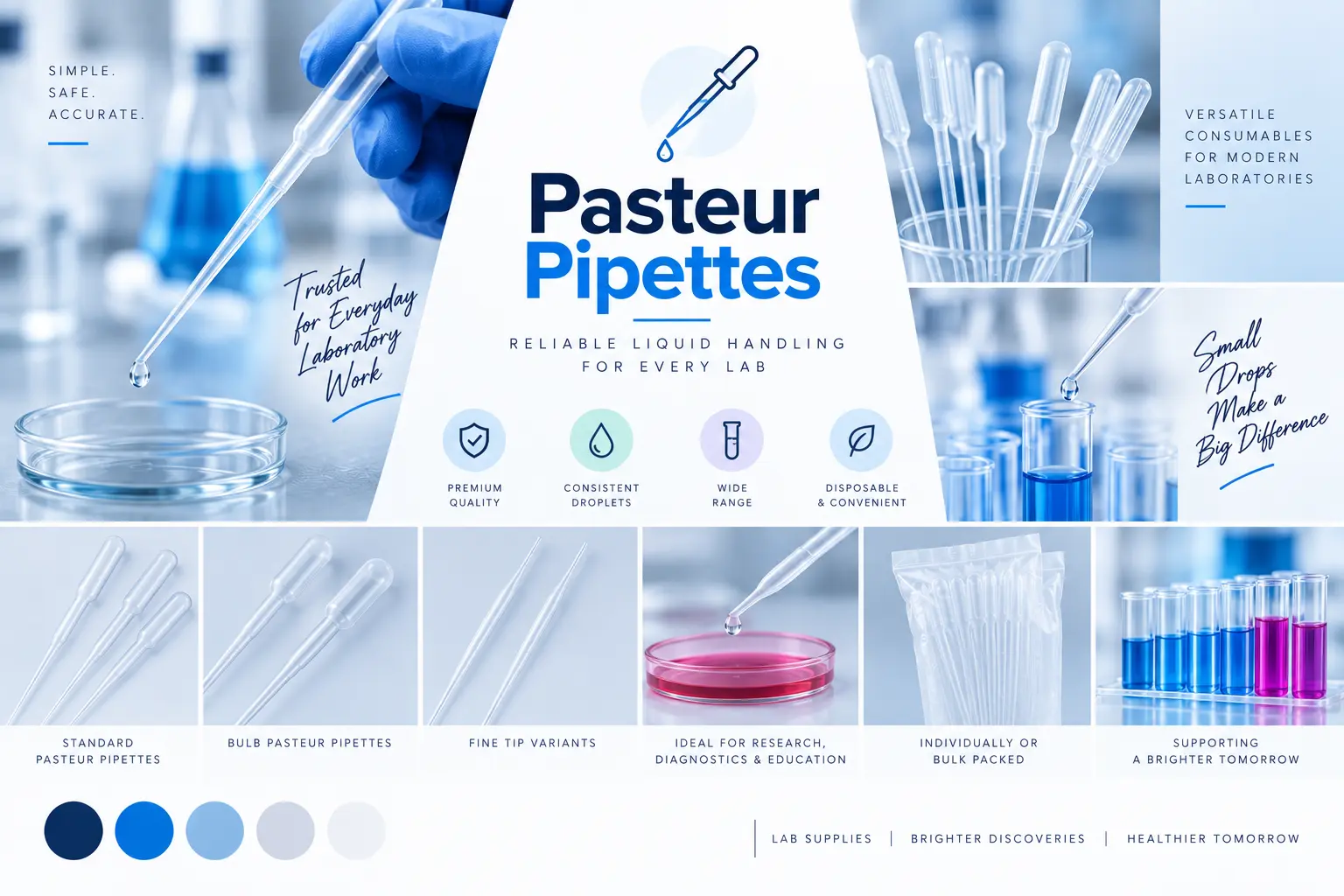
Pasteur Pipettes
Features
- Precisely Tapered Long Tip for Accurate Small-Volume Liquid Transfer & Dispensing
- Non-Toxic LDPE Plastic Construction for Chemical Resistance & Flexible Adaptability
- Rubber Bulb Aspiration System for Safe, Controlled One-Handed Liquid Handling
- Disposable Single-Use Design for Cross-Contamination Prevention & Sterility Assurance
- Available in Short & Long Tip Configurations for Versatile Container Access
- Clinically Applicable Across Blood Banks, Haematology, Bacteriology & General Laboratory Use
- Cost-Effective, Lightweight & Easy to Use for Routine High-Volume Laboratory Workflows
Pasteur Pipette Disposable Plastic Transfer Pipette for Small-Volume Liquid Handling in Clinical, Microbiology, Research & Pharmaceutical Laboratory Applications
The Pasteur Pipette also known as a transfer pipette, dropper pipette, or teat pipette is one of the most fundamentally important and universally utilised liquid handling consumables in clinical and research laboratory practice. Named after the French scientist Louis Pasteur, who used a variant of them extensively during his research, the Pasteur pipette is a device used to transfer small quantities of liquids used in the laboratory and also to dispense small amounts of liquid medicines. Despite the extraordinary advances in laboratory instrumentation and precision liquid handling technology that have occurred since Pasteur's time, the fundamental simplicity, operational versatility, and cost-effectiveness of the Pasteur pipette have ensured its continued indispensability across the full spectrum of modern laboratory disciplines from routine clinical diagnostics and blood banking through microbiological sample processing, cell culture maintenance, pharmaceutical preparation, and molecular biology support workflows.
Historical Context & Scientific Legacy
The Pasteur pipette represents one of the most enduring scientific instrument legacies in the history of laboratory science. This liquid handling tool was first used by the famous scientist Louis Pasteur in the 19th century Pasteur is well known for the pasteurisation process, and the Pasteur pipettes were named after him. Pasteur's use of narrow-tipped glass capillary tubes for the controlled transfer and manipulation of biological specimens including his landmark experiments on spontaneous generation, fermentation, and germ theory demonstrated the foundational utility of the tapered-tip liquid transfer principle that the modern Pasteur pipette operationalises in its plastic, disposable, mass-produced form. The transition from the hand-blown glass capillaries of Pasteur's laboratory to the precision-moulded LDPE plastic pipettes of contemporary clinical practice represents a manufacturing evolution that has preserved the essential functional simplicity of the original design while dramatically expanding its accessibility, sterility assurance, and practical usability across high-volume laboratory workflows.
Material Science: Why LDPE Is the Optimal Pasteur Pipette Material
Pasteur pipettes made of non-toxic LDPE (Low-Density Polyethylene) this material has good transparency, flexibility, and drug resistance, is elastic for adaptable use in almost all containers, and will not cause leakage. The selection of low-density polyethylene as the primary construction material for modern disposable Pasteur pipettes reflects a carefully considered material science decision that balances the multiple, sometimes competing requirements of an effective laboratory liquid handling consumable. Chemical resistance is the most critical material property for a pipette that will contact the broad range of reagents, buffers, biological specimens, and pharmaceutical solutions encountered across clinical and research laboratory environments and LDPE's resistance to a wide range of aqueous solutions, dilute acids and bases, alcohols, and common laboratory reagents meets this requirement effectively across the vast majority of routine Pasteur pipette applications.
Glass is preferred for organic solvents or corrosive substances, while plastic is suitable for aqueous solutions sterilisation requirements vary between clinical or aseptic needs. For applications involving strong organic solvents, concentrated acids, or highly reactive chemical species that would degrade LDPE, glass Pasteur pipettes remain the appropriate material choice and the availability of both plastic and glass variants ensures that the correct material can be selected for each specific laboratory application without compromising either chemical compatibility or practical usability. The transparency of LDPE additionally enables visual monitoring of liquid aspiration and dispensing allowing the laboratory technician to visually confirm complete tip filling, detect air bubble formation, and observe the liquid meniscus during dispensing visual feedback that is directly relevant to the accuracy and reproducibility of the liquid transfer being performed.
Clinical Laboratory Applications: The Diagnostic Setting
Pasteur pipettes are multifaceted and are used in a variety of contexts within the laboratory: scientific research facilitates the transfer of reagents without contaminating samples, and in medicine and pharmacology they are essential for preparing and administering solutions in accurate doses. In the clinical diagnostic laboratory the setting in which the accurate, contamination-free processing of patient specimens directly influences diagnostic accuracy and clinical decision-making the Pasteur pipette serves critical functions across multiple analytical platforms and specimen types. In blood banking, the gentle aspiration of separated serum or plasma from clotted whole blood specimens requires the controlled, low-shear liquid transfer that the rubber bulb-equipped Pasteur pipette delivers without the haemolysis risk that more forceful aspiration methods generate. In haematology, the transfer of staining reagents to blood film slides and the preparation of diluted specimens for cell counting require the precise, drop-by-drop liquid dispensing that the tapered tip enables. In bacteriology and microbiology, the inoculation of culture media, the preparation of serial dilutions, and the transfer of isolated colonies between culture vessels are all routine applications that the Pasteur pipette handles effectively and safely within the single-use disposable format that infection control requires.
Sterility, Sterilisation & Packaging: Meeting Clinical Aseptic Requirements
Sterile disposable plastic Pasteur pipettes can be pre-sterilised and individually packaged, ensuring sterility and minimising the risk of contamination in sensitive applications such as cell culture and microbiology. The availability of gamma-sterilised or ethylene oxide-sterilised Pasteur pipettes in individually wrapped sterile packaging addresses the most demanding aseptic requirements of clinical and biological research applications providing a guaranteed sterile liquid handling instrument for each individual sample transfer step without the validation burden, equipment cost, and cycle time of in-house sterilisation programmes. Individually wrapped sterile units are ideal for GMP or cleanroom environments, while bulk packs are suited for routine tasks. This packaging flexibility individually wrapped sterile units for aseptic applications and bulk-packed non-sterile units for routine non-critical liquid transfer tasks allows laboratories to select the appropriate sterility assurance level and cost profile for each application category within their workflow, optimising both clinical safety and operational economy across the full spectrum of Pasteur pipette uses.
Cell Culture & Molecular Biology: Gentle Liquid Handling for Sensitive Applications
In cell culture laboratories, Pasteur pipettes are frequently used for gentle liquid handling to avoid damaging sensitive cells typical applications include removing spent media without disturbing adherent cells and adding fresh culture media. The gentle aspiration force that the rubber bulb aspiration mechanism delivers in contrast to the mechanical force of motorised pipette systems makes the Pasteur pipette specifically appropriate for the fragile, shear-sensitive liquid handling tasks of cell culture maintenance. Adherent cell monolayers which are disrupted by the turbulent flow and direct tip contact that higher-flow aspiration systems generate at the vessel surface can be managed safely with the Pasteur pipette's controlled, low-velocity aspiration, preserving monolayer integrity while effectively removing spent culture medium. Although high-precision micropipettes are required for critical steps, Pasteur pipettes still play a supporting role in molecular biology workflows they help improve workflow efficiency without occupying high-precision instruments.
Cotton Plug Variants: Aerosol Protection in Microbiological Applications
The availability of Pasteur pipettes with integrated cotton plugs positioned within the pipette barrel between the bulb attachment point and the liquid column provides an additional level of aerosol and contamination protection for microbiological and clinical applications in which the risk of infectious aerosol generation during pipetting is a significant biosafety consideration. The cotton plug acts as a physical barrier that prevents liquid from being drawn into the rubber bulb during over-aspiration, and that filters the air entering the pipette barrel during dispensing reducing the aerosol escape that can occur when liquid is forcefully expelled from the pipette tip in high-concentration microbial specimen processing environments.
Short Tip vs Long Tip: Clinical Selection Guidance
Disposable Pasteur pipettes come in two different sizes short tip pipettes and long tip pipettes both available with and without cotton plug options. The practical selection between short and long tip configurations is determined by the container geometry, the liquid volume, and the depth of liquid access required for each specific application. Short tip Pasteur pipettes are appropriate for shallow containers, microtitre plates, Petri dishes, and other wide-access vessels where the reduced tip length provides improved directional control during both aspiration and dispensing. Long tip pipettes are indicated for deep vessels, tall centrifuge tubes, narrow-neck volumetric flasks, and specimen collection containers where the additional tip length is required to reach the liquid surface at the base of the container without the pipette body obstructing the vessel opening.
Practical Usage Guidance: Technique for Accurate Transfer
While not suitable for precise measurements, Pasteur pipettes excel in simple, fast, and low-cost fluid handling tasks in general laboratory use pairing with rubber bulbs or aspirators improves control and safety, minimising aerosol or oral suction risks. Correct Pasteur pipette technique compressing the rubber bulb fully before inserting the tip into the liquid, releasing the bulb slowly to aspirate the desired liquid volume, and dispensing by progressively recompressing the bulb maximises transfer accuracy and minimises aerosol generation during clinical specimen handling. The pipette tip should be maintained in contact with the vessel wall during dispensing to guide the liquid flow and prevent droplet formation that could contaminate surrounding surfaces. Used pipettes should be discarded in appropriate laboratory waste containers in accordance with the clinical waste management regulations applicable to the specimen type handled.
Indicated For:
Blood bank serum and plasma transfer, haematology specimen preparation and staining reagent dispensing, bacteriology and microbiology culture medium inoculation and serial dilution, cell culture media aspiration and addition, molecular biology support liquid handling, pharmaceutical solution preparation and dispensing, clinical chemistry reagent addition, histology and cytology specimen processing, eye drop and liquid medication dispensing in clinical settings, general laboratory liquid transfer where non-volumetric small-volume handling is required, and any laboratory or clinical application requiring single-use, contamination-free, small-volume liquid aspiration and dispensing across research, diagnostic, and pharmaceutical production environments.
Add your review
Your email address will not be published. Required fields are marked *
Please login to write review!
Looks like there are no reviews yet.

M. A. Medical Supports