
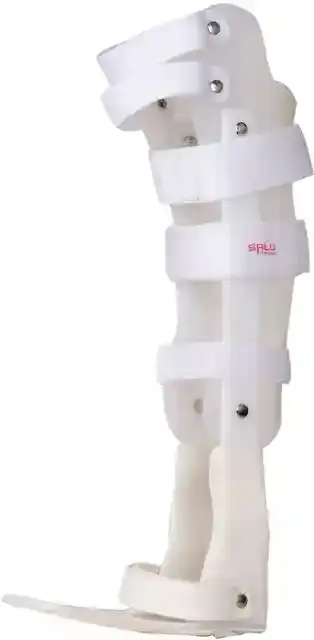
PTB With Foot Plate Brace
Features
- Integrated Foot Plate for Complete Distal Limb Offloading & Ankle Control
- Dual-Mechanism Offloading: Patellar Tendon Bearing Plus Foot Plate Support
- Adjustable Calf Shell-to-Foot Plate Clearance for Optimised Tibial Offloading
- Lateral Metal Uprights for Structural Stability & Load Transfer
- Intimate Contact Fit for Effective Proximal Support & Load Distribution
- Lightweight, Trimmable Polypropylene Shell for Clinical Customisation
- Hygienic, Skin-Safe, Odour-Free & Fully Washable Construction
PTB Brace with Foot Plate Full Below-Knee Patellar Tendon Bearing Orthosis for Tibial Fracture Management, Ankle Offloading & Protected Weight-Bearing Rehabilitation
The PTB Brace with Foot Plate is a comprehensive below-knee patellar tendon bearing ankle-foot orthosis (PTB-AFO) designed to deliver maximum tibial and distal limb offloading while simultaneously controlling ankle joint motion the defining clinical advantage that distinguishes this configuration from the foot plate-free PTB variant. The patellar tendon bearing brace was introduced by Dr. Sarmiento in the 1960s as a treatment option for tibia fractures, working by increasing the space between the calf clamp shells and the foot plate to reduce pressure on the tibia, fibula, and foot bones a biomechanical principle that remains as clinically relevant and effective today as when it was first described, and that this with-plate design applies in its most complete and mechanically comprehensive form.
The Biomechanical Case for the Foot Plate Configuration
The addition of a rigid foot plate to the standard PTB calf shell transforms the orthosis from a proximal offloading device into a fully integrated ankle-foot orthosis with both proximal load transfer and distal ankle stabilisation capabilities. The foot plate serves two distinct but complementary clinical functions. First, it provides a stable, anatomically shaped plantar support surface that distributes the residual weight-bearing load the portion that is not transferred proximally through the patellar tendon bearing mechanism broadly and evenly across the entire plantar foot rather than allowing it to concentrate at the heel and metatarsal heads. The primary objective of the PTB brace with foot plate is redistributing the weight-bearing forces normally seen at the foot and ankle to the patellar tendon and the foot plate ensures that whatever residual plantar load remains is managed in a controlled, distributed manner that protects vulnerable structures.
Second, the rigid connection created between the calf shell and the foot plate eliminates free ankle motion controlling inversion, eversion, and plantarflexion simultaneously. This three-plane ankle control is the critical clinical feature that makes the with-plate configuration specifically appropriate for lower third tibial and fibular fractures, where uncontrolled ankle movement would transmit torsional and bending forces directly to the fracture site, potentially disrupting the callus formation and bony union that are the primary goals of conservative fracture management.
Optimising Offloading Through Foot Plate Clearance Adjustment
One of the most clinically significant and practically valuable features of the PTB brace with foot plate is the ability to precisely control the degree of tibial offloading by adjusting the vertical distance between the calf shells and the foot plate. Research has demonstrated that the PTB brace provides varying levels of offloading ranging from 22% to 38%, with offloading levels increasing significantly as the vertical distance between the calf shells and foot plate increases providing the orthotist with a quantifiable, adjustable offloading parameter that can be modified at each clinical review to match the evolving load-bearing requirements of the healing fracture. In the early stages of fracture management, a greater clearance may be prescribed to maximise offloading; as healing progresses and the fracture site becomes more mechanically stable, the clearance can be progressively reduced to gradually reintroduce normal mechanical loading in a controlled, clinically guided manner.
Clinical Applications: Fractures, Diabetic Foot & Beyond
The PTB brace is used to offload the foot in plantar ulcers, diabetic foot, Charcot joint, ankle instability, pain from arthritis condition, pes planus, and avascular necrosis of the talus and the with-plate configuration is particularly indicated in conditions where ankle motion restriction is an additional clinical requirement alongside tibial and plantar offloading. For lower third tibial and fibular fractures, the foot plate's ankle control prevents the rotational and bending forces generated by unconstrained ankle movement from reaching the fracture site a consideration of particular importance in distal third fractures, where the mechanical relationship between ankle motion and fracture site stress is more direct and potentially more damaging than in more proximal shaft fractures.
For Charcot joint (neuroarthropathy) management, the with-plate configuration provides both the hindfoot offloading that protects the demineralised bone architecture from pathological compressive loading and the ankle motion control that prevents the shear and torsional forces that drive progressive deformity in the active phase of the condition. In two patients, the absence of mechanical forces on the foot and ankle in the orthosis allowed the swelling and erythema of the active phase of Charcot arthropathy to resolve within several weeks, with maintenance of functional ambulation during the months required for healing of the Charcot process a compelling illustration of the clinical value of complete ankle and foot offloading in this challenging condition.
For plantar ulcer and diabetic foot management, the foot plate provides the consistent, even load distribution across the plantar surface that reduces the peak plantar pressures at the ulcer site pressures that are the primary mechanical driver of wound non-healing and deterioration in the insensate neuropathic foot. The complete enclosure of the foot within the orthotic system also provides a degree of protection from external mechanical trauma, a secondary but clinically significant benefit in patients with peripheral neuropathy who cannot detect injurious contact forces through normal sensory pathways.
A Clinically Superior Alternative to the PTB Cast
The PTB brace has become a popular alternative to traditional PTB casts due to its ease of cleaning, convenience, and improved hygiene advantages that carry significant practical and clinical weight across the extended wearing periods that tibial fracture management and chronic conditions such as Charcot arthropathy and diabetic foot ulceration require. Unlike the plaster PTB cast, this brace can be removed for limb washing, skin inspection, wound care, and physiotherapy enabling the regular monitoring of skin integrity and wound progress that is essential in high-risk patients, and allowing the prescribing clinician to assess fracture healing and adjust the orthotic prescription without the delay and inconvenience of cast removal and replacement.
The polypropylene shell construction is fully resistant to standard cleaning agents and can be wiped down or washed as needed a fundamental hygiene advantage over plaster in the management of patients with open wounds, plantar ulcers, or incontinence. The non-porous, antimicrobial surface does not absorb perspiration or support bacterial colonisation, maintaining a clean, odour-free interface with the patient's skin throughout extended daily use.
Fabrication, Fitting & Ongoing Management
The PTB brace with foot plate is custom-fabricated from thermoplastic polypropylene sheeting vacuum-formed over a positive model of the patient's limb, producing a device that conforms anatomically to the individual's proximal tibia and calf with the precise patellar tendon bearing relief and tibial flare contact required for effective load transfer. The lateral metal uprights connecting the calf shell to the foot plate are individually adjusted during fitting to achieve the prescribed clearance distance and the ankle position required by the clinical prescription. Adjustable Velcro straps allow rapid, independent daily application and removal and accommodate limb volume changes throughout the healing process without requiring orthosis refabrication at each clinical review.
Indicated For:
Lower third tibial and fibular fractures requiring ankle motion restriction, mid-shaft tibial fractures requiring maximum tibial offloading, Charcot joint (neuroarthropathy) management in the active and consolidation phases, diabetic neuropathic foot and plantar ulcer offloading, avascular necrosis of the talus, post-operative protected weight-bearing following ankle and hindfoot surgery, painful ankle arthritis with instability, pes planus with distal limb pain, and any condition requiring combined proximal tibial offloading and controlled restriction of ankle inversion, eversion, and plantarflexion during ambulation and rehabilitation.
Add your review
Your email address will not be published. Required fields are marked *
Please login to write review!
Looks like there are no reviews yet.

M. A. Medical Supports