
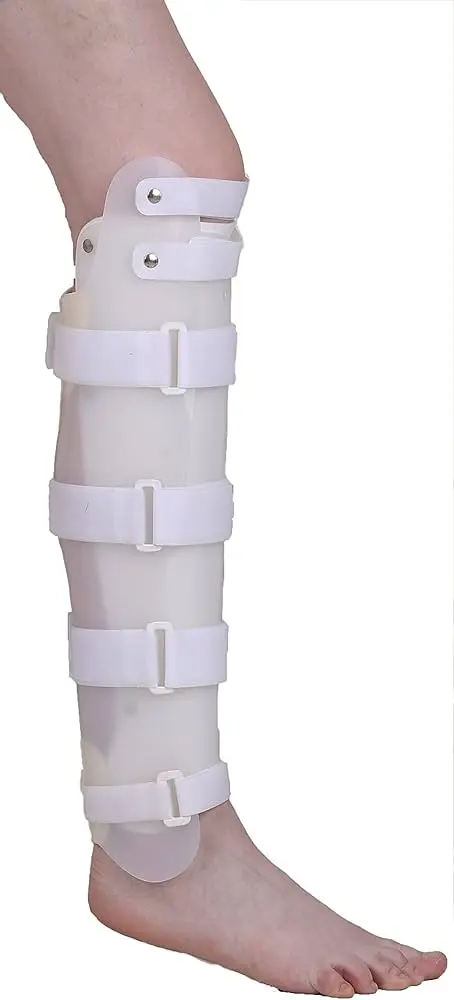
PTB Without Plate
Features
- Patellar Tendon Bearing Mechanism for Effective Tibial Offloading
- Without Foot Plate for Preserved Ankle & Foot Joint Mobility
- Lightweight, Durable Polypropylene Shell for Daily Clinical Use
- Adjustable Velcro Straps for Volume-Responsive Secure Fit
- Hygienic, Skin-Safe & Odour-Free Construction
- Clinically Indicated Across a Wide Spectrum of Below-Knee Conditions
- Supports Early Protected Weight-Bearing for Improved Rehabilitation Outcomes
PTB Orthosis Without Foot Plate Patellar Tendon Bearing Below-Knee Brace for Tibial Offloading, Fracture Management & Protected Weight-Bearing Rehabilitation
The PTB Orthosis Without Foot Plate is a clinically established below-knee orthotic device designed on the foundational principle of patellar tendon bearing a biomechanical offloading mechanism that transfers body weight through the soft tissue structures surrounding the patella and the medial and lateral tibial flares, rather than through the distal skeletal structures of the tibia, fibula, ankle, and foot. Originally conceived by Sarmiento in the 1960s for the functional management of tibial fractures, the PTB concept has since been applied across a broad and clinically diverse range of below-knee conditions where reduction of compressive axial load on the distal limb is the primary therapeutic objective. The without-plate configuration specifically preserves free movement at the ankle and foot joints a critical clinical advantage in conditions where joint mobility, circulation, and early functional loading are rehabilitation priorities.
The Biomechanical Rationale: How Patellar Tendon Bearing Offloads the Lower Limb
The patellar tendon bearing mechanism operates by creating a proximal load transfer pathway that bypasses the compromised distal structures of the lower limb. The orthosis is custom-moulded to apply consistent, controlled pressure over the pressure-tolerant soft tissue regions of the proximal tibia specifically the patellar tendon below the patella, the tibial flares medially and laterally, and the fibular head while simultaneously relieving contact pressure over the distal tibia, ankle joint, and plantar surface of the foot. During weight-bearing, body weight is transmitted through this proximal interface rather than axially through the bone column and ankle joint, with the PTB brace providing varying levels of offloading ranging from 22% to 38% depending on the specific configuration and fitting parameters a clinically meaningful reduction in mechanical loading that creates the protected environment required for fracture consolidation, wound healing, and tissue recovery.
The Clinical Significance of the Foot Plate-Free Design
The distinction between a PTB orthosis with and without a foot plate carries significant clinical implications. A PTB orthosis with a foot plate creates a rigid connection between the calf shell and the plantar surface, locking the ankle and foot into a fixed position. While this provides additional distal offloading and stabilisation in conditions such as Charcot joint disease or plantar ulceration, it simultaneously eliminates physiological ankle motion preventing the normal heel-to-toe rolling gait pattern and restricting the ankle joint mobility that is essential for maintaining joint health, muscular function, and circulatory efficiency during rehabilitation.
The without-plate design removes this constraint entirely, allowing the ankle and foot to move freely through their natural range of motion during ambulation. This preservation of physiological joint movement actively promotes osteogenesis at fracture sites through the beneficial effects of cyclical joint loading, maintains peroneal and calf muscle activation during walking, supports healthy venous return from the lower limb, and prevents the joint contracture and muscle atrophy that commonly develop when the ankle is immobilised for extended periods. For patients in the subacute and rehabilitation phases of fracture management or wound care, this functional mobility advantage frequently translates into significantly better long-term outcomes than prolonged immobilisation approaches.
Broad Clinical Applicability Across Below-Knee Pathologies
The PTB orthosis without plate is prescribed across a remarkably diverse range of clinical presentations, reflecting the fundamental versatility of the patellar tendon bearing offloading principle. In tibial and fibular fracture management, it enables the transition from full-length casting to functional bracing with protected weight-bearing accelerating rehabilitation, reducing muscle wastage, and supporting earlier return to daily activities without compromising fracture healing. In diabetic foot management, it offloads the plantar surface and distal foot structures during the healing of neuropathic ulcers, reducing the pressure-related mechanical stress that is the primary driver of wound breakdown and non-healing in the insensate diabetic foot. In Charcot joint management, it controls the weight distribution through the affected foot and ankle during the active phase of the condition, protecting the fragile, demineralised bone architecture from the pathological loading that drives progressive deformity.
Additional indications include avascular necrosis of the talus where offloading the ankle joint during the ischaemic and revascularisation phases is essential to prevent collapse of the necrotic bone chronic ankle instability requiring proximal load redistribution, painful ankle arthritis where reduction of joint compressive forces provides meaningful symptomatic relief, and post-operative protected weight-bearing following ankle and hindfoot surgical procedures where the operating surgeon requires a defined period of reduced mechanical loading during the early healing phase.
Fabrication, Fitting & Clinical Customisation
The polypropylene shell of the PTB orthosis without plate is fabricated using standard orthotic lamination or vacuum-forming techniques over a positive model of the patient's limb, producing a device that conforms precisely to the individual contours of the proximal tibia and calf. The thermoplastic material can be trimmed and heat-modified during fitting to achieve the exact trim lines, pressure relief zones, and patellar tendon bearing relief that the individual patient's anatomy and clinical condition require a degree of customisation that is essential for achieving the correct offloading effect without creating injurious pressure at bony prominences. The adjustable Velcro strap system allows straightforward daily application and removal by the patient or carer, and accommodates the limb volume changes that occur during the healing process without requiring refabrication of the entire orthosis.
Indicated For:
Tibial and fibular shaft fractures (functional bracing), diabetic neuropathic foot and plantar ulcer offloading, Charcot joint (neuroarthropathy) management, avascular necrosis of the talus, chronic ankle instability, painful ankle and hindfoot arthritis, pes planus with distal limb pain, post-operative protected weight-bearing following ankle and hindfoot surgery, and any condition requiring controlled reduction of axial compressive load on the distal tibia, fibula, ankle, or plantar foot structures during ambulation and rehabilitation.
Add your review
Your email address will not be published. Required fields are marked *
Please login to write review!
Looks like there are no reviews yet.

M. A. Medical Supports