
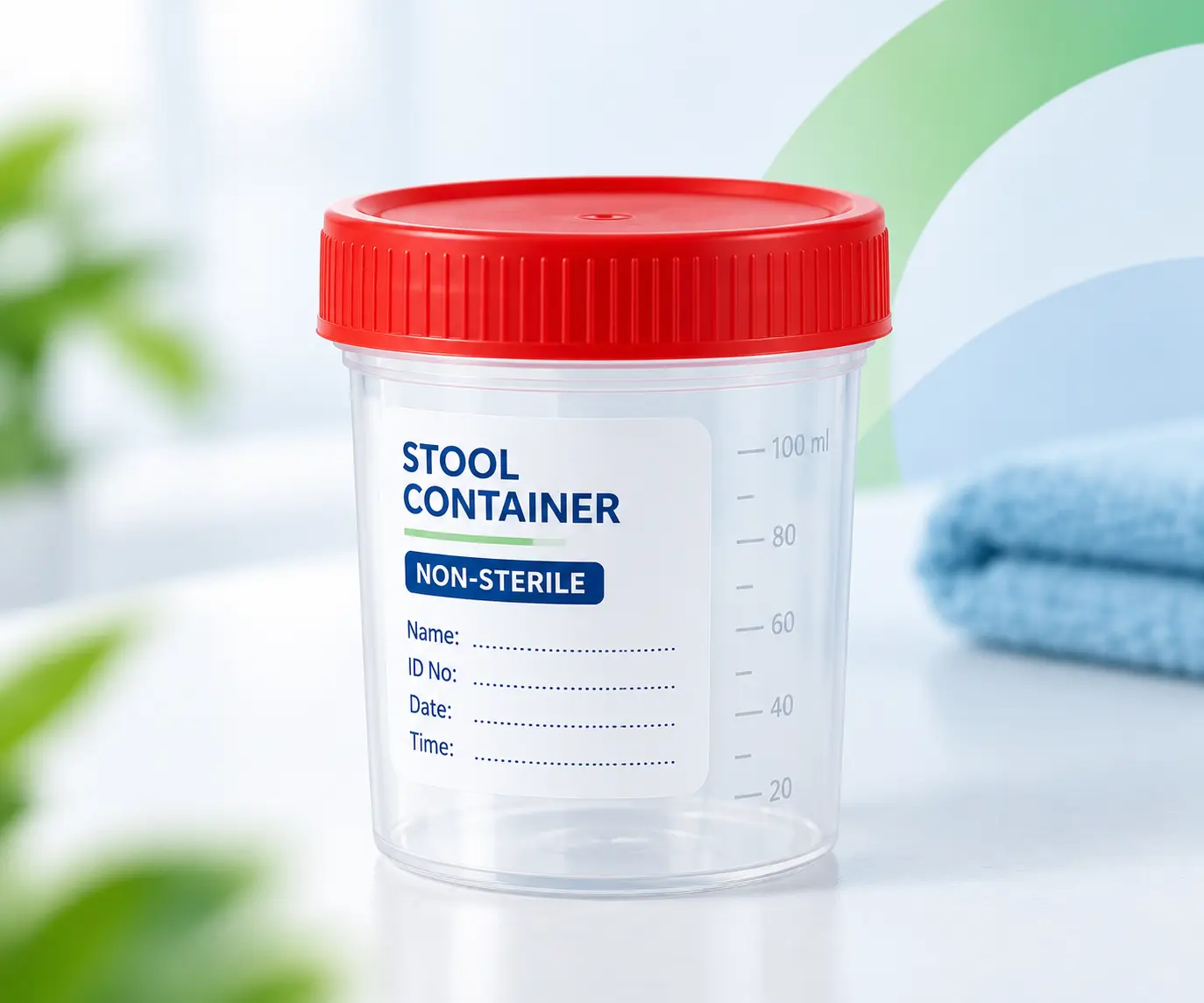
Stool containers
Features
- Wide-Mouth Opening for Easy, Hygienic Stool Specimen Transfer & Self-Collection
- Integrated Sampling Scoop in Secure Screw-Cap for Measured, Contamination-Free Collection
- Secure Leak-Proof Screw-Cap Closure for Safe Biohazard Transport & Storage
- Clinically Applicable Across Culture, Parasitology, C. difficile, FOBT & Molecular Diagnostics
- Moulded Graduated Volume Scale for Accurate Fill-Level Assessment & Laboratory Processing
- Compatible with Preservative Fixatives for Extended Specimen Stability During Transport
- Clearly Labelled with Patient Information & Biohazard Identification for Safe Chain of Custody
Stool Containers Medical-Grade Faecal Specimen Collection Pots for Culture, Parasitology, Occult Blood Testing, C. difficile & Comprehensive Gastrointestinal Diagnostics
Stool Containers also known as faecal specimen pots, stool specimen cups, or faecal collection containers are purpose-designed, medical-grade specimen collection vessels engineered to provide the clean, hygienic, and structurally secure collection environment that accurate faecal diagnostic testing demands across the full spectrum of clinical laboratory gastrointestinal investigation pathways. Laboratory examination of fecal samples is an important component of some diagnoses physicians and clinicians often test stool samples as a component of testing for colon or rectal cancer or to identify bacteria or viruses that may be involved in an infection additionally, some diagnostics require isolating and assaying nucleic acids, proteins, fats, or other analytes present in a stool sample. The stool container addresses every critical pre-analytical variable in the faecal specimen management chain from the patient-centred collection design that facilitates accurate self-sampling at home, through the leak-proof transport security that protects personnel from biohazardous exposure, to the chemical material compatibility that preserves specimen integrity across the transport conditions and preservative systems required by diverse diagnostic analytical platforms.
The Clinical Necessity of Standardised Faecal Specimen Collection
The diagnostic value of faecal specimen analysis across gastrointestinal medicine, infectious disease, oncology, and parasitology is considerable and the accuracy of laboratory test results derived from stool specimens is directly dependent on the quality of the pre-analytical collection procedure. Unlike blood and urine specimens where standardised venepuncture and clean-catch collection techniques are universally understood by both patients and clinical staff faecal specimen collection presents unique practical, hygiene, and patient acceptability challenges that the stool container's design must resolve to ensure consistent specimen quality across the diverse patient population who perform stool collection independently at home.
Collect the stool in a dry, clean, leakproof container make sure no urine, water, soil or other material gets in the container ensure that the specimen containers are sealed well. The stool container's design operationalises each of these critical collection requirements: the wide mouth enables unobstructed specimen transfer without toilet water or foreign material contamination; the smooth, non-porous inner surface provides a clean collection vessel free from the disinfectant and detergent residues that bedpans and domestic containers carry; and the precision screw-cap creates the leak-proof sealed environment that prevents specimen loss and biohazardous fluid leakage during the transport interval between home collection and laboratory receipt.
Stool Specimen Types: Matching Collection to Diagnostic Purpose
Stool specimen collection and handling products are specialised to address the challenges of obtaining patient stool samples for diagnostic testing stool samples may be collected randomly or over a several-day period products for stool specimen collection include swabs, commode inserts, metal cans, and transport, concentration and sample prep containers filled with various fixatives, solutions, and dyes. The clinical selection of the appropriate stool container format standard sterile pot, preservative-containing vial, or multi-compartment dual-fixative kit is determined by the specific diagnostic test requested and the analytical platform requirements of the receiving laboratory.
For routine bacterial culture and sensitivity testing including the investigation of Salmonella, Shigella, Campylobacter, Escherichia coli, and other enteric pathogens in acute gastroenteritis presentations a clean, sterile wide-mouth container without fixative preserves the viability of the bacterial organisms during the transport to the laboratory. For Clostridium difficile toxin testing the most important single cause of antibiotic-associated diarrhoea in hospitalised patients collect a minimum of 2 mL of stool sample in an appropriately labelled sterile container specimens should be liquid or soft, as formed, hardened stool specimens are not acceptable for Clostridium difficile testing store and transport to the laboratory at 2–8°C. This specific consistency requirement for C. difficile testing and the refrigerated transport requirement illustrate the specimen-type specificity that effective stool container prescription requires.
Ova & Parasite Testing: Preservative Systems & Dual-Vial Collection
The ova and parasite test is a microscopic examination of stained fresh or preserved stool to detect the presence of worms or other parasites or their eggs stool samples for ova and parasite testing may be added to pre-filled containers that contain preservatives, fixatives, growth media, or stains. The diagnosis of intestinal parasitic infection including Giardia lamblia, Cryptosporidium parvum, Entamoeba histolytica, and helminthic ova requires the preservation of parasite morphological integrity from the point of collection to the moment of microscopic examination, a requirement that is met through the addition of the collected stool specimen to pre-filled fixative-containing vials that stabilise protozoan cyst morphology and helminth egg architecture across the transport interval.
Because 10% formalin and PVA have complementary advantages, it is recommended that the specimen be divided and preserved in both types of preservatives commercial two-vial kits are available for this purpose preserved specimens can be stored for several months. The availability of dual-vial ova and parasite collection kits pre-filled with complementary fixative systems that together provide comprehensive protozoan and helminth preservation across the full diagnostic spectrum of intestinal parasitology significantly simplifies specimen management by providing a single, pre-packaged collection system that meets all laboratory fixation requirements without requiring the patient or clinical staff to prepare individual fixative solutions at the point of collection.
Faecal Occult Blood Testing: Colorectal Cancer Screening
Fecal occult blood testing is performed to detect blood that can be visually observed samples for occult blood testing may be collected using a swab or a gloved finger the feces are spread on a test surface to which a developer or indicator is added. Faecal occult blood testing (FOBT) including guaiac-based and faecal immuno-chemical test (FIT) variants is the primary screening modality for colorectal cancer in the general population, detecting the microscopic blood loss into the gastrointestinal lumen that early colorectal polyps and cancers generate before symptoms develop. The stool container for FOBT applications incorporates a sampling probe or brush that transfers a controlled, standardised specimen volume to the test card or collection vial ensuring that the quantity of stool applied to the analytical surface is consistent between patients and between collection occasions, a critical pre-analytical requirement for quantitative FIT testing where the result threshold for colonoscopy referral is calibrated against a specific specimen volume.
Molecular Diagnostics: Nucleic Acid Extraction & PCR Testing
The rapid expansion of molecular diagnostic platforms including multiplex PCR panels for comprehensive gastrointestinal pathogen detection covering bacterial, viral, and parasitic targets simultaneously has created new stool container requirements for nucleic acid preservation from the point of collection to the point of extraction. Some diagnostics require isolating and assaying nucleic acids, proteins, fats, or other analytes present in a stool sample for samples collected by the patient in their home, a container holding the collected sample must be suitable not only for storage of the sample until it is received in the lab, but also for transport and shipping of the sample to the lab where it will be examined. Nucleic acid preservation buffer-containing stool containers which immediately lyse cellular components and inhibit nuclease activity upon specimen addition are specifically designed for molecular diagnostic applications, maintaining RNA and DNA integrity across ambient temperature transport conditions that would degrade nucleic acids in unpreserved specimens.
Patient Instruction: The Critical Determinant of Specimen Quality
Collect the stool specimen in any clean, dry wide-mouth container, bedpan, or on a plastic plate or clean newspaper, plastic bag, or clean diaper this prevents the faecal specimen from falling into the toilet bowl collection device must not be sent to the laboratory the stool sample must be transferred to the appropriate transport device before being sent to the laboratory. The effectiveness of patient instruction in correct stool specimen collection technique is the single most important determinant of specimen quality across community and outpatient gastrointestinal diagnostic pathways. Clear, illustrated written instructions provided with each stool container addressing toilet positioning, specimen capture without toilet water contamination, correct scoop fill volume, cap sealing, labelling, storage, and transport directly influence the proportion of specimens that meet laboratory acceptance criteria and the frequency of specimen rejection with its associated patient inconvenience, diagnostic delay, and repeat collection burden.
Transport, Storage & Pre-Analytical Stability Requirements
The stool container must be bagged separately from other specimens the bag must be leakproof there must be absorbent material between the primary receptacle and the secondary packaging that is able to absorb the entire contents of the bag. The international transport regulations for Category B biological specimens including faecal specimens containing potential enteric pathogens require the stool container to be enclosed within a sealed biohazard bag with sufficient absorbent material to contain the full volume of the container's contents in the event of leakage, as the primary biosafety measure protecting transport personnel from biohazardous exposure during specimen transit. Store and transport to the laboratory at 2–8°C for the majority of bacteriological and parasitological diagnostic tests, with the specific temperature and timing requirements varying by test type making correct patient and clinical staff education regarding post-collection storage conditions an essential component of the stool collection instruction programme.
Indicated For:
Bacterial culture and sensitivity for acute infectious gastroenteritis pathogens including Salmonella, Shigella, Campylobacter, and E. coli, Clostridium difficile toxin testing in antibiotic-associated diarrhoea, ova and parasite examination for intestinal parasitic infection including Giardia, Cryptosporidium, Entamoeba, and helminthic ova, faecal occult blood testing for colorectal cancer screening, faecal immunochemical testing (FIT), multiplex PCR molecular gastrointestinal pathogen panel testing, faecal calprotectin measurement for inflammatory bowel disease monitoring, faecal elastase testing for exocrine pancreatic insufficiency, Helicobacter pylori stool antigen testing, norovirus and rotavirus antigen detection, fat malabsorption investigation, and any clinical or research application requiring clean, sterile, leak-proof collection and transport of faecal specimens for microbiological, parasitological, biochemical, immunological, or molecular diagnostic analysis.
Add your review
Your email address will not be published. Required fields are marked *
Please login to write review!
Looks like there are no reviews yet.

M. A. Medical Supports