
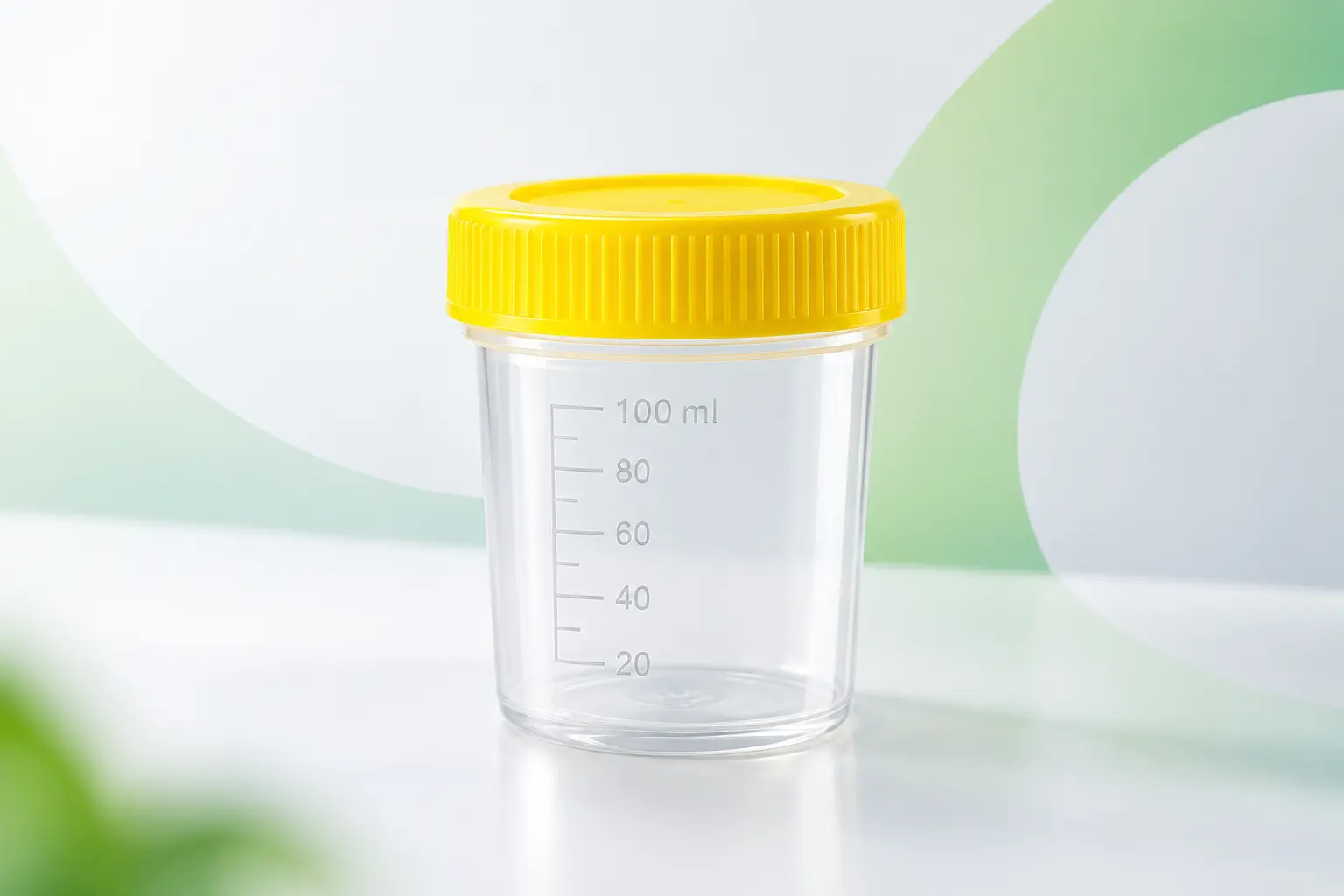
Urine Containers
Features
- Gamma-Sterilised for Guaranteed Sterility Assurance Across All Microbiological Applications
- Wide-Mouth Opening for Comfortable, Spill-Free Self-Collection by Patients
- Secure Leak-Proof Screw-Cap Closure for Safe Specimen Transport & Storage
- Moulded Graduated Volume Markings for Accurate Specimen Volume Assessment
- Clinically Applicable Across Urinalysis, Culture, Drug Screening & 24-Hour Collection
- Non-Toxic Polypropylene or Polyethylene Construction for Chemical Compatibility
- Clearly Labelled with Patient Information Fields for Specimen Traceability & Chain of Custody
Sterile Urine Containers Medical-Grade Leak-Proof Specimen Collection Cups for Urinalysis, Microbiological Culture, Drug Screening & Comprehensive Clinical Urine Diagnostics
Sterile Urine Containers are purpose-designed, gamma-sterilised medical-grade specimen collection vessels engineered to provide the clean, contamination-free, and structurally secure collection environment that accurate urine diagnostic testing requires across the full spectrum of clinical laboratory applications. Collection and transportation of urine specimens to the clinical laboratory are important because variables such as collection method, container, transportation, and storage affect the analysis outcome and consequently diagnostic and therapeutic decisions based on the results. The sterile urine container addresses every critical variable in this specimen management chain providing guaranteed sterility at the point of collection, a secure leak-proof transport seal, chemical material compatibility with urine and its preservative additives, and the patient-usable wide-mouth design that enables unassisted, accurate clean-catch midstream self-collection across the diverse patient population who perform urine specimen collection independently in both clinical and community care settings.
The Clinical Importance of Container Sterility in Urine Diagnostics
The distinction between a clean and a sterile urine container is clinically decisive in microbiological diagnostic applications. Specimens submitted for routine urinalysis should be collected in clean, dry containers a sterile container with a lid is required for microbiological cultures. This differentiation reflects the fundamental diagnostic principle that urine culture results — the basis for antibiotic prescription decisions in urinary tract infection management are valid only when the specimen is collected in a truly sterile vessel whose internal surfaces are guaranteed free from any pre-existing microbial contamination. A nominally clean but non-sterile container may harbour low-level environmental bacterial contamination that grows rapidly in the warm, nutrient-rich medium of urine during specimen transport, producing false-positive culture results, spurious antibiograms, and clinically misleading diagnoses that drive inappropriate antibiotic prescribing a consequence with direct implications for patient outcomes, antimicrobial stewardship, and healthcare resource utilisation.
The interpretive consequences of specimen contamination are significant: the interpretation of cytobacteriological study results will very often be falsified by indirect contamination of the urine specimen, of which the isolated or associated causes include the exposed edge of the flask opening being touched by fingers, the stopper being set down on any non-sterile surface, accidental and frequent dropping of the stopper, and prolonged exposure of sterile inner surfaces to non-sterile free air throughout the period of urination. The sterile urine container's design incorporating a factory-sealed, gamma-sterilised vessel with a precision-fitted screw-cap that maintains the sterility of the container interior until the point of use directly addresses each of these contamination pathways, providing a collection system whose sterility is preserved throughout the collection procedure even when performed by patients without clinical training or supervision.
Clean-Catch Midstream Collection: The Most Clinically Critical Collection Technique
The clean-catch midstream urine collection technique in which the patient cleanses the urethral meatus, initiates voiding, allows the first portion of the urine stream to wash away urethral flora, and then collects the midstream portion in the sterile container is the universally accepted standard for urine collection intended for microbiological culture analysis. Products for urine collection for culture include sterile containers and supplies for producing clean-catch or midstream urine specimens urine specimens for culture are collected in a manner that reduces the possibility of contamination by bacteria from body surfaces. The wide-mouth design of the sterile urine container facilitates this collection technique by providing a sufficiently large collection aperture for the midstream catch to be directed into the container without interrupting the urine stream a practical consideration that is particularly important for female patients, elderly individuals, and patients with limited manual dexterity for whom the precision required to direct the urine stream into a narrow-mouth container represents a significant collection challenge.
Specimen Types & Analytical Applications: Matching Container Selection to Clinical Need
The sterile urine container is appropriate across the full spectrum of urine specimen types and diagnostic applications encountered in routine clinical laboratory practice. A randomly collected specimen may be collected at unspecified times and is often more convenient for the patient a random specimen is suitable for most screening purposes. The first morning specimen or 8-hour specimen the patient should be instructed to collect the specimen immediately upon rising from a night's sleep. The random specimen collected at any time of day without specific timing requirements is the most commonly collected urine type, suitable for routine urinalysis, urine pregnancy testing, urine drug screening, and general biochemical screening. The first morning specimen collected immediately upon waking before any hydration has occurred provides the most concentrated urine sample, maximising the sensitivity of protein, glucose, and microbiological detection in clinical screening programmes.
Timed urine specimens may be collected for chemical analyses to assess kidney function typically analysed for protein and creatine, the urine may also be tested for elevated levels of other metabolic waste products. For 24-hour urine collections the gold standard for quantitative assessment of renal protein excretion, creatinine clearance, and metabolic waste product production appropriately sized collection vessels with graduated volume markings, preservative compatibility, and secure leak-proof closures are required to maintain specimen integrity across the full collection period during which the patient accumulates and refrigerates the total urinary output.
Drug Screening Applications: Chain-of-Custody & Specimen Integrity
Collecting urine specimens for drugs of abuse testing may require special procedures and products that track temperature and record chain-of-custody. In workplace and medico-legal drug screening contexts, the urine container functions not merely as a specimen vessel but as the first link in a documented chain-of-custody chain that must demonstrate unbroken specimen identity and integrity from the point of collection through the entire analytical pathway to the final reported result. The sterile urine container's tamper-evident seal, patient information labelling surface, and compatible temperature-monitoring strip attachment capability support the chain-of-custody documentation requirements of forensic, employment, and regulatory drug screening programmes.
Specimen Stability, Preservatives & Transportation Requirements
The urine specimen should be plated for culture within 2 hours from the collection time if the specimen is kept at room temperature alternatively, these tests may be performed within 24 hours of collection if the specimen is stored at 2°C to 8°C before processing. The pre-refrigeration stability window of two hours for unpreserved urine specimens at room temperature is a clinically important constraint that determines the practicality of urine culture testing in community and primary care settings where laboratory access may be delayed. The sterile urine container's compatibility with boric acid preservative which is added to the collection vessel during manufacture in some product variants extends this stability window to 24 to 48 hours at ambient temperature by inhibiting the bacterial multiplication that would otherwise invalidate the quantitative culture result during the specimen transport period.
Urine specimens should be delivered within 2 hours of collection or refrigerated and transported to the lab as soon as possible. The container's leak-proof screw-cap closure maintains specimen containment integrity during the transport of refrigerated or ambient-temperature specimens through primary care, community, and hospital ward transport systems protecting courier personnel, postal staff, and laboratory reception staff from the biohazardous urine exposure that leaking specimen containers generate.
Laboratory Processing: Aliquot Preparation & Multi-Test Distribution
Upon receipt in the clinical laboratory, the sterile urine container serves as the primary specimen vessel from which aliquots are distributed to the multiple analytical platforms that a complete urine workup typically requires. It is commonly used in clinical and laboratory settings to gather samples for analysis of various health indicators, such as kidney function, glucose levels, infection, or drug screening. The standard urine request may simultaneously require urinalysis by reagent strip, microscopic examination of the centrifuged sediment, quantitative culture and sensitivity testing, and additional chemistry tests each requiring a separate aliquot from the primary collected specimen. The wide-mouth container design facilitates the pipette and automated aliquoting access required for this multi-platform specimen distribution process, allowing efficient laboratory processing without the specimen transfer difficulties that narrow-mouth containers impose in high-throughput laboratory environments.
Prompt processing of urine has traditionally been recommended to ensure accuracy of quantitative culture results, urinalysis, and microscopy this is important in making slides, in that fresh cells stick to the glass slide much better than cells from preserved urine, allowing a smoother cell spread onto the glass body. The time-from-collection-to-processing constraint in urine cytology where cellular morphology preservation is critical to diagnostic accuracy requires container systems that maintain specimen integrity from the collection point to the laboratory processing bench, with the sterile urine container's sealed, opaque or translucent construction providing both microbiological containment and protection from the UV-induced cellular degradation that light-transparent containers allow during transport.
Paediatric Urine Collection: Specialist Container Variants
Products for timed urine specimen collection include sterile containers, urine collection kits, and paediatric urine collection products. Paediatric urine collection presents unique practical challenges the inability of infants and young children to void on demand, the small urine volumes produced, and the anatomical difficulty of directing the urine stream into a standard collection container require specialist paediatric collection bag systems that adhere to the perineal region and collect voided urine directly into a sealed, sterile collection pouch. These paediatric collection variants are available in sterile, individually wrapped formats that maintain collection sterility comparable to adult clean-catch specimens, providing the microbiologically reliable paediatric urine specimens required for the accurate diagnosis and management of urinary tract infections in the neonatal and infant population.
Catheter Specimen Collection: Aseptic Aspiration from Indwelling Catheters
For hospitalised patients with indwelling urinary catheters in whom the collection of a clean-catch midstream specimen is not possible the sterile urine container receives the specimen obtained by aseptic aspiration from the catheter sampling port. When necessary, urine specimens in patients with indwelling bladder catheters should be obtained by sterile aspiration through the catheter port or by puncturing the catheter tubing with a needle and syringe if a port is not present. The catheter-aspirated specimen transferred from the sterile syringe into the sterile urine container provides the most microbiologically representative bladder urine specimen available for catheterised patients, and its accurate culture interpretation requires the same container sterility standards as clean-catch specimens from non-catheterised patients.
Practical Guidance: Patient Instruction, Labelling & Transport
Clinical staff are responsible for patient instruction, collection, and labelling of urine specimens and timely transportation of specimens to the laboratory. Effective patient instruction in clean-catch midstream collection technique is the single most important determinant of specimen quality in community and outpatient urine culture diagnostic pathways and the clarity and simplicity of the written instruction materials provided with the sterile urine container directly influence the proportion of specimens that meet the cytological and bacteriological criteria for valid culture interpretation. The container should be labelled immediately at the point of collection with the patient's full name, date of birth, collection date, collection time, and specimen type and transported to the laboratory within the specified pre-analytical stability window for the requested tests, either at ambient temperature within two hours or refrigerated at 2–8°C within 24 hours.
Indicated For:
Routine urinalysis by reagent strip and microscopy, urine culture and antibiotic sensitivity testing for suspected urinary tract infection, clean-catch midstream urine collection, catheter specimen urine culture, urine pregnancy testing, urine drug and substance of abuse screening, renal function monitoring including protein and creatinine measurement, 24-hour urine collection for quantitative biochemical analysis, urine cytology and cytopathology specimen collection, paediatric urine collection in age-appropriate specialist container variants, and any clinical or laboratory application requiring a sterile, leak-proof, wide-mouth specimen collection vessel for the safe, contamination-free collection, transport, and storage of urine specimens across inpatient, outpatient, community, occupational health, and medico-legal diagnostic settings.
Add your review
Your email address will not be published. Required fields are marked *
Please login to write review!
Looks like there are no reviews yet.

M. A. Medical Supports