
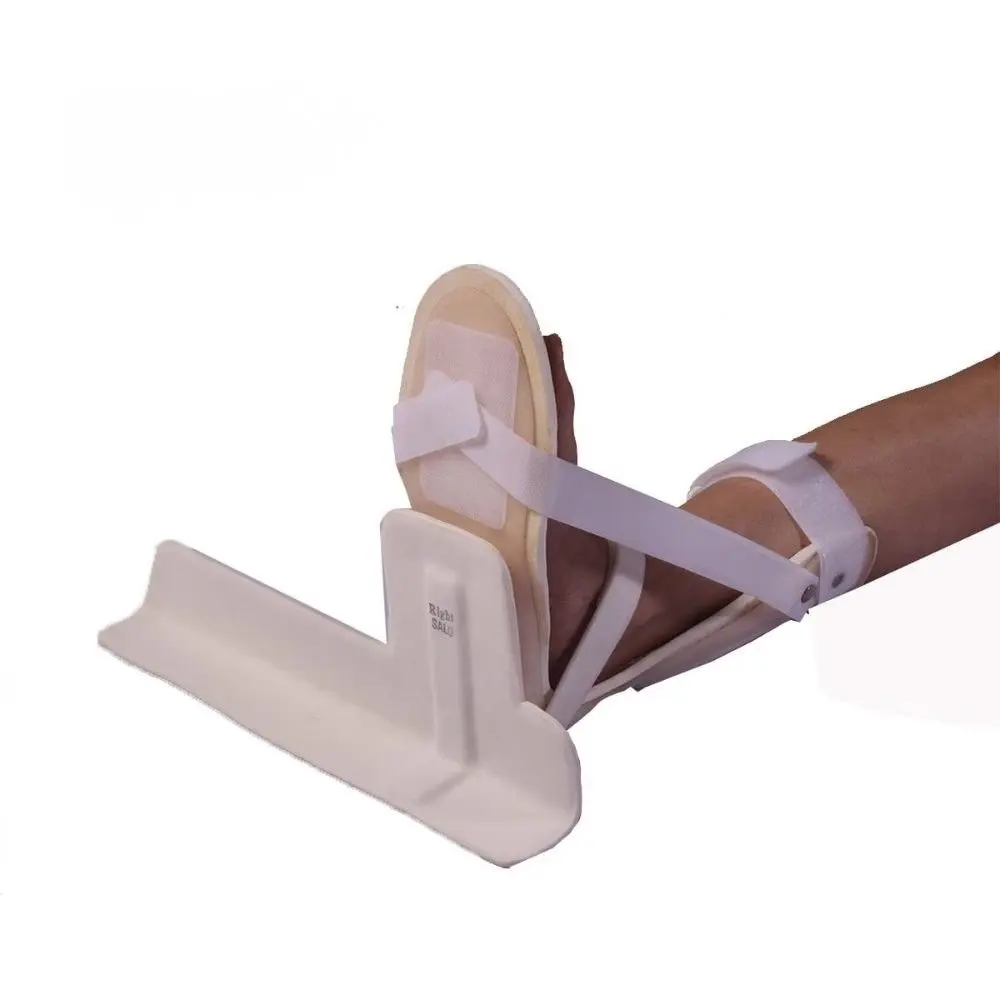
Foot Drop Splint with Detachable Bar
Key Features
- Detachable Derotation Bar for Versatile Clinical Use
- Adjustable Bilateral Dorsiflexion Straps
- Shaped Toe Wedge for Plantar Fascia Stretch
- Open-Heel Cut-Out for Pressure Ulcer Prevention
- Comfortable Padded Calf & Ankle Straps
- Lightweight One-Piece Flexible Shell
- Hygienic, Skin-Safe & Fully Washable
Foot Drop Splint with Detachable Bar — Multi-Functional AFO for Foot Drop Management, Contracture Prevention & Lower Limb Rehabilitation
The Foot Drop Splint with Detachable Bar is a clinically versatile ankle foot orthosis (AFO) engineered to address the complex, evolving needs of patients at different stages of foot drop management and lower limb rehabilitation. Its defining feature — a removable derotation bar — transforms a single orthotic device into a dual-purpose solution: a comprehensive positioning and stabilisation splint for recumbent or critically ill patients, and a functional ambulation brace for those engaged in active gait rehabilitation.
Understanding Foot Drop & Why This Splint Works
Foot drop occurs when weakness or paralysis of the dorsiflexor muscles prevents the front of the foot from being lifted during walking, causing the toes to drag along the ground. This results in an abnormal, compensatory gait pattern characterised by hip hiking or circumduction, significantly increasing the risk of falls, joint stress, and secondary musculoskeletal injury. The Foot Drop Splint with Detachable Bar directly addresses this by maintaining the ankle in a functional dorsiflexed position, raising the forefoot sufficiently to prevent toe drag, and eliminating the uncontrolled forefoot slapping that occurs at heel strike — restoring a safer, more controlled walking pattern.
The Detachable Bar: Clinical Versatility in One Device
The detachable derotation bar is the feature that sets this splint apart from standard foot drop AFOs. When attached, the bar prevents unwanted internal or external rotation of the lower limb — a critical consideration for bedridden patients, those in the acute phase post-stroke, or individuals recovering from spinal cord injury or major lower limb surgery, where uncontrolled limb rotation can compromise joint alignment and healing. When the bar is removed, the splint transitions seamlessly into a lightweight ambulatory AFO suitable for active therapy, walking practice, and community use — eliminating the need for multiple devices across the care continuum.
Progressive Stretch Therapy Built Into the Design
The adjustable bilateral dorsiflexion straps allow clinicians and physiotherapists to apply a precisely controlled, progressive stretch to the plantar flexor muscle group. This is clinically beneficial for managing early-stage plantarflexion contractures, improving range of motion in patients with plantar fasciitis and Achilles tendonitis, and maintaining soft tissue extensibility in patients at risk of developing equinus deformity. The toe wedge augments this therapeutic stretch, directing tension specifically into the plantar fascia — making this splint an effective conservative tool within a broader musculoskeletal treatment programme.
Pressure Care & Patient Safety at Its Core
The open-heel design is a non-negotiable clinical feature for any patient with limited mobility, directly offloading the calcaneus — a site disproportionately vulnerable to pressure injury in immobile or critically ill patients. This open configuration, combined with the padded calf and ankle straps, ensures that forces are distributed safely across the limb without creating dangerous localised pressure zones, particularly important in patients with reduced sensory awareness, peripheral vascular disease, or fragile skin integrity.
Durable, Hygienic & Built for Long-Term Use
The lightweight, one-piece thermoplastic shell is engineered to withstand the demands of repeated daily application without deforming or fatiguing structurally. Its non-absorbent, antimicrobial surface is resistant to sweat, bacteria, and odour, and the entire splint is fully washable — meeting the hygiene standards required in both institutional care and home-based rehabilitation settings. The overall construction ensures that clinical effectiveness is maintained throughout extended use, supporting long-term patient compliance.
Indicated For: Foot drop (flaccid and mild spastic), peroneal nerve palsy, post-stroke gait rehabilitation, spinal cord injury, multiple sclerosis, cerebral palsy, Guillain-Barré syndrome, plantar fasciitis, Achilles tendonitis, plantarflexion contracture prevention, equinus deformity management, post-operative lower limb recovery, and critical care or ICU lower limb positioning.
Add your review
Your email address will not be published. Required fields are marked *
Please login to write review!
Looks like there are no reviews yet.

M. A. Medical Supports