
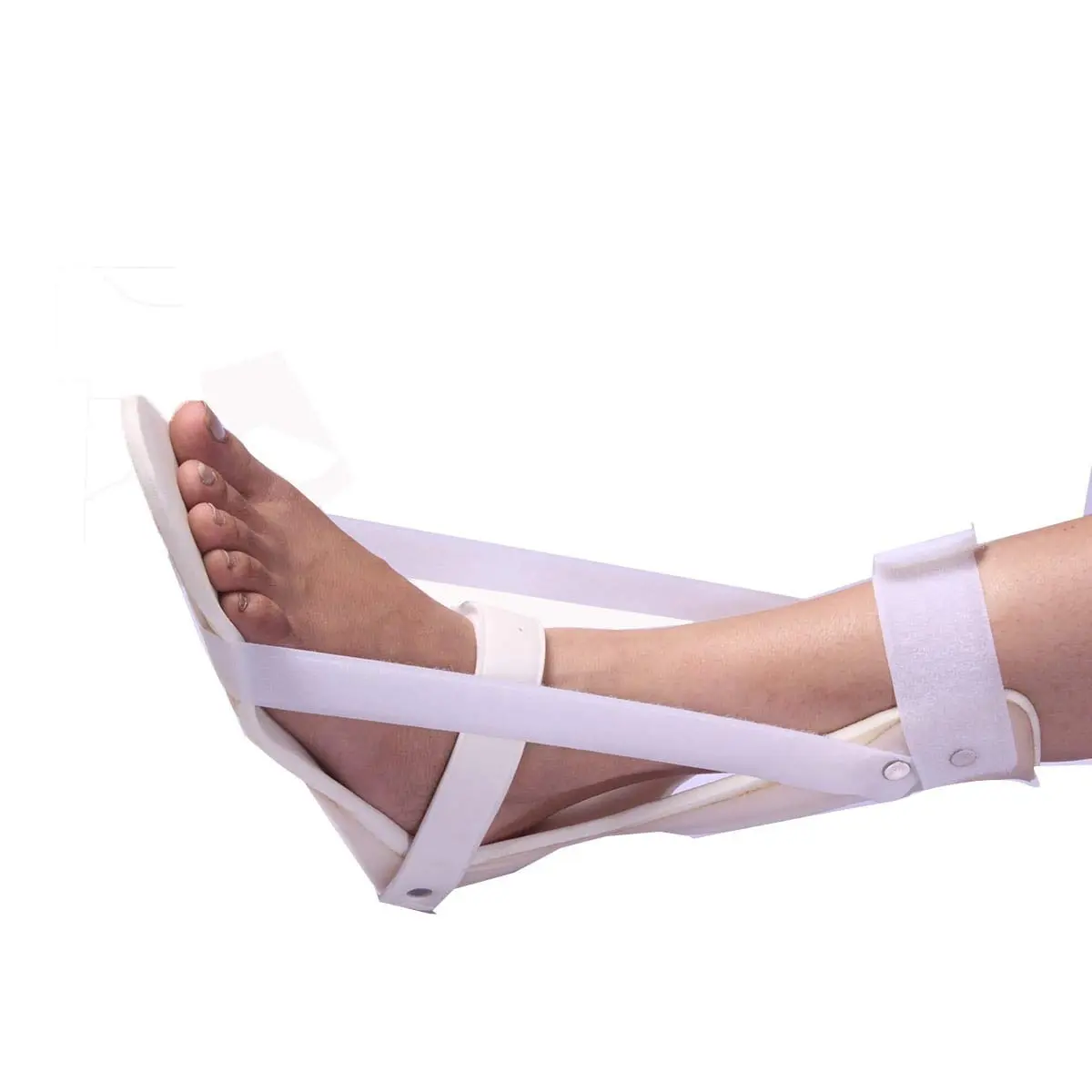
Static Foot Drop Splint (Full Padding)
Key Features
- Fixed 90° Neutral Ankle Positioning
- Full-Contact Padded Interior Lining
- Open-Heel Design for Pressure Ulcer Prevention
- Detachable Derotation Bar for Limb Stability
- Toe Wedge for Plantar Fascia Stretch
- Padded Calf & Ankle Straps for Secure Fit
- Hygienic, Skin-Safe & Easy to Maintain
Static Foot Drop Splint with Full Padding — Clinically Designed Positioning Orthosis for Foot Drop, Contracture Prevention & Pressure Care
The Static Foot Drop Splint with Full Padding is a purpose-engineered foot drop positioning orthosis that combines rigid static ankle support with comprehensive full-contact cushioning to deliver both functional correction and exceptional patient comfort. Designed for use across clinical, rehabilitation, and home care settings, this splint is particularly well-suited to bedridden patients, post-operative recovery, intensive care, and individuals undergoing neurological rehabilitation who require consistent, passive ankle positioning throughout periods of reduced or absent mobility.
The Clinical Case for Static Positioning
Unlike dynamic or spring-loaded AFOs designed for active ambulation, the static foot drop splint serves a distinct and essential clinical purpose: maintaining the ankle in a fixed neutral position (0° dorsiflexion) to prevent the progressive shortening of the plantar flexor muscles and tendons that occurs when the foot rests unsupported in a plantarflexed posture. Left unmanaged, this soft tissue tightening can lead to a fixed plantarflexion contracture — a complication that significantly impairs future rehabilitative progress and long-term functional recovery. Early and consistent use of a static positioning splint is a clinically recommended preventive measure in stroke care, spinal cord injury management, and critical care nursing.
Full-Padding: Comprehensive Protection for Vulnerable Skin
The defining feature of this splint over standard static AFOs is its full-contact padded interior. Rather than limiting padding to isolated pressure points, the full-length foam lining provides continuous, even cushioning across the entire plantar surface, posterior calf, and malleolar regions. This is particularly significant for patients with peripheral neuropathy, reduced skin sensation, or fragile skin integrity, where undetected pressure can rapidly progress to tissue damage and ulceration. The padding system ensures that orthotic corrective forces are distributed broadly rather than concentrated — a key principle in pressure injury prevention.
Open-Heel Configuration & Derotation Support
The open-heel cut-out is a clinically essential feature for patients confined to bed or wheelchair, completely eliminating contact-related pressure over the calcaneus — one of the highest-risk anatomical sites for pressure ulcer formation. Complementing this, the detachable derotation bar prevents the lower limb from rotating outward under the influence of gravity during supine positioning, maintaining neutral lower extremity alignment and reducing stress on the hip joint — an important consideration in elderly, post-surgical, and neurologically impaired patients.
Practical for Patients, Carers & Clinicians
The splint's adjustable padded straps allow carers and healthcare professionals to apply and remove the device quickly and safely, with closures that can be adapted to changes in limb volume over time. The integrated toe wedge provides a passive stretch to the plantar fascia and Achilles tendon during wear — supporting soft tissue extensibility as part of a broader conservative management programme. The entire device is constructed from a non-absorbent, washable, odour-resistant material that meets the hygiene demands of both institutional and home care environments.
Indicated For: Foot drop management in ambulatory and non-ambulatory patients, plantarflexion contracture prevention, post-stroke rehabilitation, spinal cord injury care, critical care and ICU positioning, peroneal nerve palsy, multiple sclerosis, cerebral palsy, Guillain-Barré syndrome, post-operative lower limb recovery, and patients at high risk of heel pressure ulceration.
Add your review
Your email address will not be published. Required fields are marked *
Please login to write review!
Looks like there are no reviews yet.

M. A. Medical Supports